How to Use AI for Sales Prospecting and Cut Work to Minutes
Sales prospecting has long been essential to growth—but rarely efficient. AI changes this by replacing manual research and fragmented workflows with intelligent systems that run continuously in the background, helping teams focus on the right conversations instead of busywork.
Sales prospecting has always driven growth, but it has rarely been efficient. Most B2B teams still spend hours researching companies, finding decision-makers, verifying contacts, writing outreach, and managing follow-ups—long before a real conversation even begins.
AI for sales prospecting changes this by removing much of that manual work altogether. When implemented correctly, AI doesn’t just automate individual tasks. It transforms prospecting into a continuous system that runs in the background, reducing hours of effort to minutes of strategic oversight.
Adopting AI for prospecting isn’t about adding more tools—it’s about replacing fragmented workflows with intelligent systems. The sections below explore how AI-driven prospecting works, why traditional methods no longer scale, and how platforms like Oppora are enabling a more autonomous outbound motion.
What Is AI for Sales Prospecting?
At a surface level, AI for sales prospecting refers to using artificial intelligence to help sales teams find, engage, and qualify potential customers. But this definition alone doesn’t capture the real transformation taking place.
Many tools today apply AI to narrow functions—such as drafting emails, enriching contacts, or suggesting leads. In these setups, AI behaves like an assistant: helpful, but limited. The sales rep still owns the process, stitching together tools and managing outcomes manually.
True AI-driven sales prospecting works differently. Instead of assisting with individual steps, AI operates across the entire outbound lifecycle as a connected system.
This includes:
- Discovering relevant companies dynamically
- Identifying and prioritizing decision-makers
- Verifying contact information before outreach
- Running multi-step outbound workflows
- Interpreting replies and qualifying intent
- Booking meetings and syncing outcomes to CRM
In this model, AI doesn’t just support prospecting—it runs it. Sales teams intervene only when judgment, negotiation, or relationship-building is required. This shift from assistance to ownership is what makes AI prospecting fundamentally different from traditional automation.
And it’s precisely why older prospecting methods are starting to break under scale.
Why Traditional Sales Prospecting No Longer Scales
To understand why AI prospecting is gaining momentum, it’s important to understand why traditional prospecting methods fail as teams grow.
Most sales teams rely on fragmented workflows. Leads are sourced in one place, enriched in another, emailed through a separate platform, and manually updated in a CRM—often involving browser-based tools or lead finder Chrome extensions that still require heavy manual coordination. Each handoff introduces friction. Data becomes outdated, follow-ups are delayed, replies are missed, and performance becomes inconsistent.
As volume increases, quality decreases. Deliverability suffers. Sales reps spend more time managing tools than talking to prospects.
AI addresses this problem not by optimizing each step independently, but by removing the gaps between steps entirely. When prospecting becomes a continuous system rather than a chain of tasks, efficiency and quality improve together.
That system-level approach is what enables smarter decision-making at scale.
Use Cases of AI in Sales Prospecting
AI supports sales prospecting across multiple stages, from account discovery to prioritization and engagement.
1. Identifying High-Intent Accounts
AI analyzes intent signals such as content engagement, website activity, hiring trends, and market behavior to identify companies actively exploring solutions.
- Detects interest before prospects reach out
- Helps sales engage earlier in the buying journey
- Reduces dependency on inbound leads alone
2. Lead and Account Prioritization
Rather than treating all prospects equally, AI ranks accounts based on likelihood to convert.
- Scores prospects using real-time and historical data
- Helps reps focus on accounts that matter most
- Improves pipeline quality, not just quantity
3. Discovering Buying Triggers
AI identifies trigger events that often precede purchase decisions.
- Leadership changes or team expansion
- Funding announcements or market growth
- Technology changes or operational shifts
These insights help sales teams approach prospects with relevant timing and messaging.
4. Improving ICP Accuracy
AI continuously refines the Ideal Customer Profile by learning from closed-won and closed-lost deals.
- Removes subjective targeting decisions
- Adapts to market changes automatically
- Aligns sales and RevOps on what “good fit” truly means
5. Reducing Manual Research and Data Gaps
AI handles data enrichment and validation, reducing reliance on manual research.
- Keeps account data fresh and accurate
- Reduces time spent switching between tools
- Improves consistency across sales teams
How Can You Use Oppora AI for Sales Prospecting
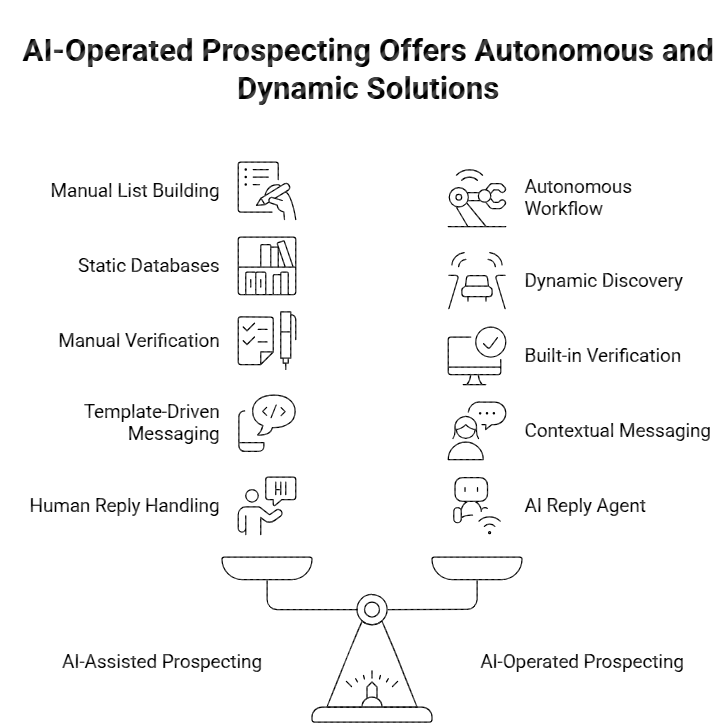
Oppora applies AI prospecting as a single, autonomous workflow rather than a collection of features.
The process begins with intent. Instead of manually building lists or configuring sequences, users tell Oppora who they want to reach and what they sell. From there, Oppora’s AI Planner constructs and runs the outbound workflow automatically.
Oppora dynamically discovers companies based on real-world signals rather than relying solely on static databases. It then identifies the most relevant roles within those companies, prioritizing contacts that historically engage in similar outreach contexts.
Before any message is sent, Oppora verifies contact details using built-in verification logic. This step protects deliverability and ensures campaigns are built on reliable data.
Outreach is generated and executed automatically. Messaging is contextual rather than template-driven, and campaigns run across multiple inboxes with warm-up and rotation handled in the background.
When replies come in, Oppora’s AI Reply Agent interprets intent, responds where appropriate, qualifies interest, and books meetings automatically. Only meaningful conversations require human involvement. Everything else runs continuously and syncs into CRM systems without manual updates.
This is the difference between AI-assisted prospecting and AI-operated prospecting.
Challenges and Considerations When Using AI for Prospecting
AI can dramatically improve sales prospecting—but it doesn’t just scale success. It scales everything. That makes how you use AI just as important as whether you use it.
Data Quality and Verification Still Matter
AI operates on the data it’s given. If lead data is outdated, unverified, or poorly targeted, AI won’t fix the problem—it will amplify it.
This is why email verification, list hygiene, and domain health are foundational when using AI for sales prospecting. Without these safeguards, even the smartest AI can damage deliverability and long-term performance.
Volume Without Control Can Hurt Deliverability
AI makes it easy to send more outreach, faster. But higher volume doesn’t automatically mean better results.
Without proper throttling and pacing, AI-driven campaigns can trigger spam filters, overwhelm inboxes, and reduce trust. Effective AI prospecting prioritizes controlled scale, not maximum output.
Over-Automation Can Reduce Relevance
Automation breaks down when messages feel generic, mistimed, or disconnected from a prospect’s context.
Prospects are quick to recognize outreach that lacks relevance. AI must account for role, company situation, and timing—not just insert variables into a template—if it’s going to support meaningful engagement.
Contextual Automation Is the Real Differentiator
The most effective AI systems don’t just know how to act—they know when to act.
That includes understanding when to:
- Pause or slow outreach
- Adjust messaging based on responses
- Hand conversations to a human
This balance prevents AI from becoming noisy or intrusive.
Controlled Autonomy Beats Blind Volume
The line between effective AI prospecting and spam isn’t intelligence—it’s control.
When AI operates within clear boundaries, with intent awareness and safeguards, it scales the pipeline sustainably. Blind volume creates activity; controlled autonomy creates trust, deliverability, and long-term results.
The Future of AI in Sales Prospecting
The future of sales prospecting is autonomous.
AI will increasingly determine who to contact, when to reach out, how to follow up, and when a human should step in. Sales teams will spend less time prospecting and more time closing, expanding, and building relationships.
Oppora is already aligned with this direction, treating prospecting as infrastructure rather than labor.
Final Conclusion
Sales prospecting will always matter—but it doesn’t need to dominate time, energy, or headcount.
Using AI for sales prospecting allows teams to replace manual effort with intelligent systems that run continuously in the background. When implemented correctly, AI improves relevance, protects deliverability, and frees teams to focus on what actually drives revenue.
Oppora is built for teams that want to stop managing prospecting and start benefiting from it.
If your goal is to cut prospecting work to minutes while increasing meaningful conversations, Oppora provides a practical, end-to-end AI solution designed for modern sales teams.