9 Best AI Sales Enablement Platforms That Improve Win
ai sales enablement platforms, best ai sales enablement tools, ai sales enablement software, ai sales automation platform, ai-powered outbound sales, ai tools for sales teams, improve sales win rates with ai, cold email automation with ai

Sales teams don’t lose deals because they lack effort. They lose because they spend time on the wrong things. Busy work feels productive, but it rarely improves win rates.
Most reps still waste hours on manual tasks. Logging data, chasing cold leads, and sending follow-ups that go nowhere. This drains time and focus from real selling.
Deals are won through timing, relevance, and clarity. Knowing who to contact and what to do next matters more than volume. This is where AI starts to change outcomes.
An ai sales enablement platform is not just another sales tool. It helps reps make better decisions faster. AI takes care of lead scoring, follow-ups, and data work in the background.
With clear signals instead of guesswork, teams act with intent. Lead quality improves. Engagement feels more relevant. Conversions follow naturally.
This guide covers the 9 best AI sales enablement platforms that help teams improve win rates. You’ll learn how each platform works, what problems it solves, and which teams benefit most.
Features to Look for in an AI Sales Enablement Platform
Once you understand why AI improves win rates, the next step is knowing what actually matters inside the tool. Not every platform delivers real value. Many add “AI” as a label, but only a few features move deals forward.
A strong AI Sales Enablement Platform should reduce decision fatigue. It should remove guesswork. Most importantly, it should help reps focus on the actions that lead to revenue, not more activity.
The features below are the ones that directly impact sales performance. They don’t just save time. They improve outcomes.
AI-Powered Lead Scoring
Not all leads deserve the same attention. AI analyzes behavior, firmographics, past conversions, and engagement patterns. It then ranks leads based on buying intent.
For example, instead of calling every inbound lead, a rep sees which prospects opened emails, visited pricing pages, or matched past winning accounts. The rep starts with the warmest leads. Conversations improve. Close rates rise.
Sales Automation That Removes Busy Work
Manual follow-ups slow teams down. AI automates emails, task reminders, and sequence steps without losing context.
Imagine a prospect who doesn’t reply after a demo. Instead of forgetting or sending a generic nudge, the system triggers a timely, relevant follow-up. Reps stay consistent without being robotic. More deals stay alive.
Predictive Analytics for Smarter Focus
Gut feeling doesn’t scale. Predictive analytics show patterns across deals, pipelines, and past wins.
Sales managers can see which deals are likely to close and which are slipping. Reps know where to spend time this week, not next quarter. Forecasts improve. Last-minute surprises are reduced.
Content Personalization That Feels Human
Generic messaging kills engagement. AI helps tailor content based on role, industry, and stage.
A CFO receives ROI-focused messaging. A sales manager sees efficiency gains. The message fits the buyer, not the template. Replies feel natural, not automated.
CRM Integration Without Data Gaps
An AI Sales Enablement Platform should work with your CRM, not against it. Data should sync automatically. No double entry. No missing fields.
When emails, calls, and notes update in real time, teams trust the system. Decisions are based on clean data. Execution becomes faster and smoother.
Together, these features create clarity. Reps know who to contact, when to act, and how to engage. That’s how AI turns effort into wins.
9 Best AI Sales Enablement Platforms for Improving Win Rates
You now know which features matter and why they impact results.
The next step is seeing how real platforms apply those features in practice.
Each tool below solves a different sales problem.
Some focus on scale. Some on precision. A few try to do everything in one place.
There is no universal “best” option.
The right platform depends on team size, deal complexity, and how much automation you need.
What matters most is this:
Does the tool help reps act faster, stay focused, and close more deals?
Below are the 9 best AI sales enablement platforms that consistently improve win rates.
1. Oppora.ai
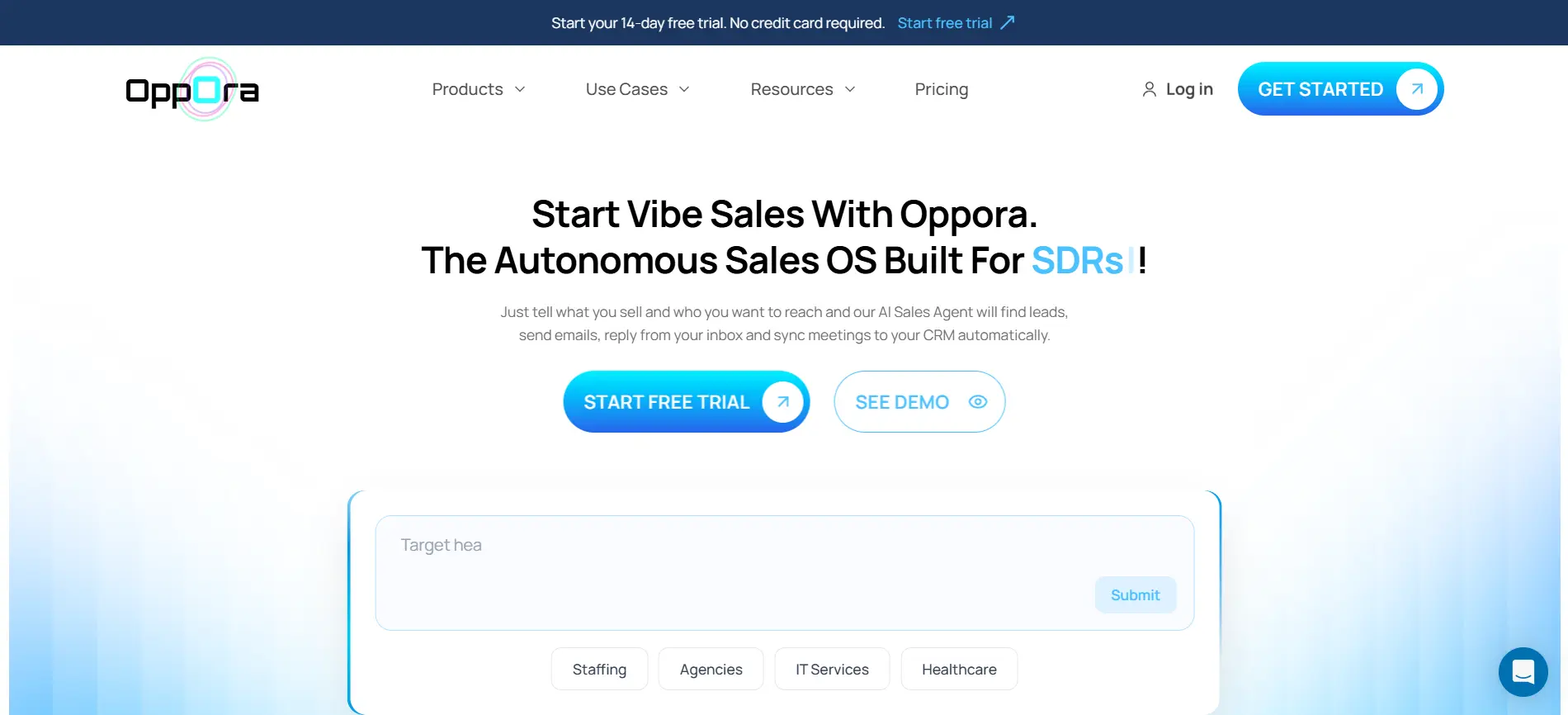
Oppora.ai is an AI sales enablement platform that automates outbound sales from lead discovery to booked meetings using agentic AI.
Sales teams define:
- Who they want to reach
- What they are selling
- Their outreach goal
Oppora plans the workflow and runs it end to end, reducing manual effort and helping teams move faster from prospecting to conversations.
Key Features
AI-driven sales workflows and automation
- Identifies target accounts automatically
- Launches outreach without manual setup
- Manages follow-ups as part of a single workflow
Continuous lead from a global database
- Pulls prospects from a 700M+ global leads and company database
- Enriches leads with role and company context
- Scores lead based on fit and engagement
Scalable outreach with built-in infrastructure
- Automatic domain warm-up
- Supports up to 50 connected mailboxes
- Scales safely to thousands of emails per day
AI-powered personalization, reply handling, and meeting booking
- Personalizes emails contextually using AI
- Handles replies automatically
- Book meetings instantly when interest is detected
Built-in CRM with external CRM integrations
- Tracks emails, replies, and deal activity automatically
- Maintains a live pipeline view
- Syncs data with existing CRM systems
Shared visibility and performance insights
- Centralized shared inbox for team visibility
- Tracks outreach activity automatically
- Reporting shows what’s working and what needs improvement
Pros
- Enables large-scale outbound without manual setup
- Keeps lead flow fresh through continuous discovery
- Improves response speed and follow-up consistency
Cons
- Requires a short learning period to adapt to the agent-based workflow
Best For
Sales teams are looking for an AI sales enablement platform that combines automated workflows, large-scale lead access, and scalable outreach to improve efficiency and win rates.
2. Salesforce
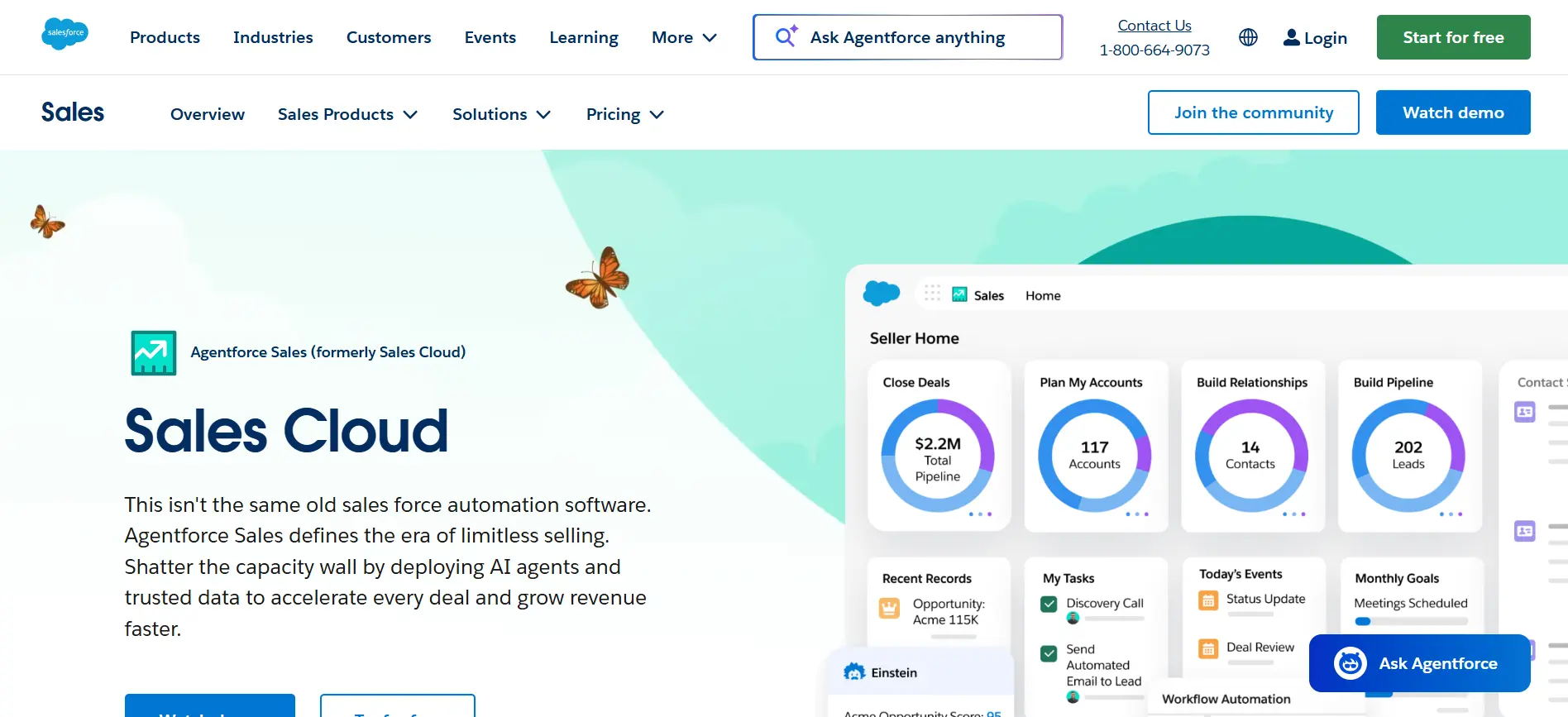
Salesforce Sales Cloud is built for scale and complexity. It supports large teams, long sales cycles, and layered approval processes.
Its AI capabilities focus on prediction and visibility. Managers can identify deals at risk weeks in advance. Reps receive suggested next steps based on historical deal patterns. Forecasting becomes more reliable as data volume grows.
The strength of Salesforce lies in control and customization. Almost every process can be configured. However, this also means longer setup times and higher costs. Smaller teams may find it overwhelming.
Salesforce works best when paired with other tools for engagement and outreach.
Key Features:
- Predictive sales analytics AI highlights deals likely to close or slip before the quarter ends.
- Workflow automation at scale Custom rules manage approvals, tasks, and deal stages across large teams.
- Enterprise CRM foundation Central system for accounts, contacts, pipelines, and reporting.
Pros:
- Deep insights,
- Enterprise-grade control
Cons:
- Expensive,
- complex to implement
Best For: Large enterprises with layered sales processes
3. HubSpot
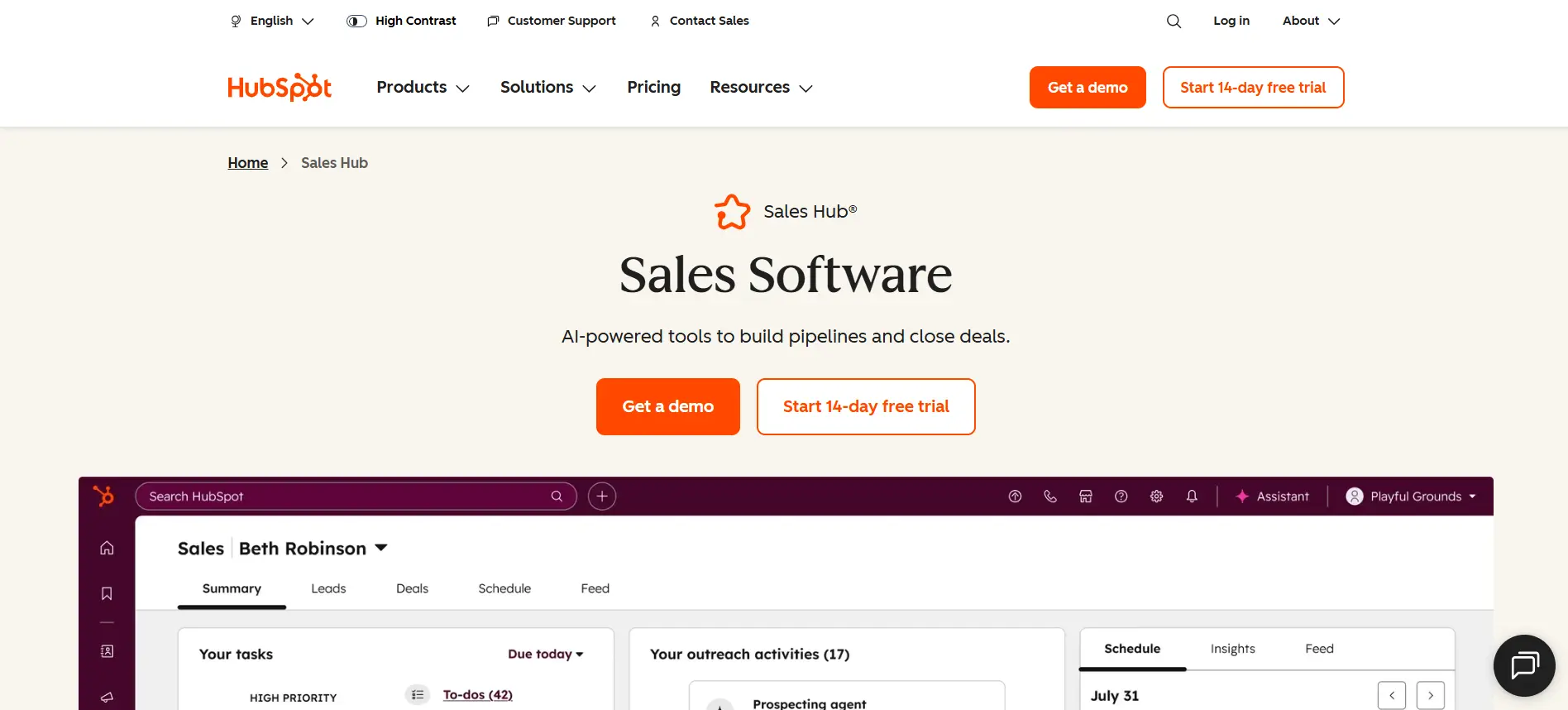
HubSpot focuses on simplicity and speed. It’s designed for teams that want to start selling quickly without heavy configuration.
Reps can track emails, schedule meetings, and manage pipelines from one place. Automation handles basic follow-ups and reminders, keeping deals from stalling.
AI features are lightweight but useful. For example, activity tracking highlights which prospects are engaging, helping reps prioritize outreach without deep analysis.
HubSpot doesn’t aim to replace advanced forecasting or engagement platforms. It works best as a clean, easy-to-use foundation.
Key Features:
- Sales automation for daily tasks Follow-ups, reminders, and pipeline updates run automatically.
- Email tracking & notifications Reps see who opened, clicked, or replied in real time.
- Built-in meeting scheduling Prospects book meetings directly without back-and-forth.
Pros:
- Easy to use
- quick setup
Cons: Limited advanced AI.
Best For: SMBs that want speed and clarity
4. Outreach
Outreach is built for engagement-heavy sales motions. It specializes in running structured sequences across email, calls, and tasks.
AI analyzes engagement data to show which messages perform best. Reps adjust quickly instead of relying on intuition. Managers gain visibility into execution quality across teams.
Outreach does not focus on lead discovery or CRM replacement. It performs best when layered on top of an existing CRM and data source.
Pricing and setup complexity make it better suited for mature sales teams.
Key Features:
- Sales engagement sequences Structured email, call, and task flows guide reps step by step.
- Message performance analytics Shows which emails and sequences generate replies.
- Execution consistency controls Managers ensure reps follow proven outreach patterns.
Pros:
- Strong analytics
- precise execution
Cons: Pricing is not SMB-friendly.
Best For: High-volume outbound teams
5. Seismic
Seismic focuses on content enablement. It helps reps use the right materials at the right time during sales conversations.
AI recommends content based on buyer role, industry, and deal stage. A finance leader sees ROI-focused assets. A sales manager sees efficiency-focused messaging. This improves relevance without manual searching.
Seismic excels when content quality directly impacts win rates. It is less focused on outreach automation or lead scoring.
Key Features:
- AI-driven content personalization Reps get the right content for the right buyer at the right stage.
- Content performance tracking Shows which assets influence deals and conversions.
- Sales training enablement Helps teams learn and reuse high-performing messaging.
Pros: Excellent content control
Cons: Less focus on outreach automation
Best For: Teams where content quality drives deals
6. Clari
Clari is built around forecasting accuracy. It shows what’s really happening inside the pipeline.
AI identifies revenue risks early. Leaders see gaps before quarter-end pressure builds. This allows proactive action instead of last-minute pushes.
Clari does not manage outreach or leads. It complements other tools by providing clarity at the leadership level.
Key Features:
- Predictive revenue analytics AI forecasts revenue based on live pipeline signals.
- Real-time pipeline visibility Leaders see deal movement, risks, and gaps instantly.
- Forecast accuracy controls Reduces end-of-quarter surprises.
Pros: Reliable forecasts
Cons: High implementation cost.
Best For: Teams obsessed with pipeline accuracy
7. Apollo.io
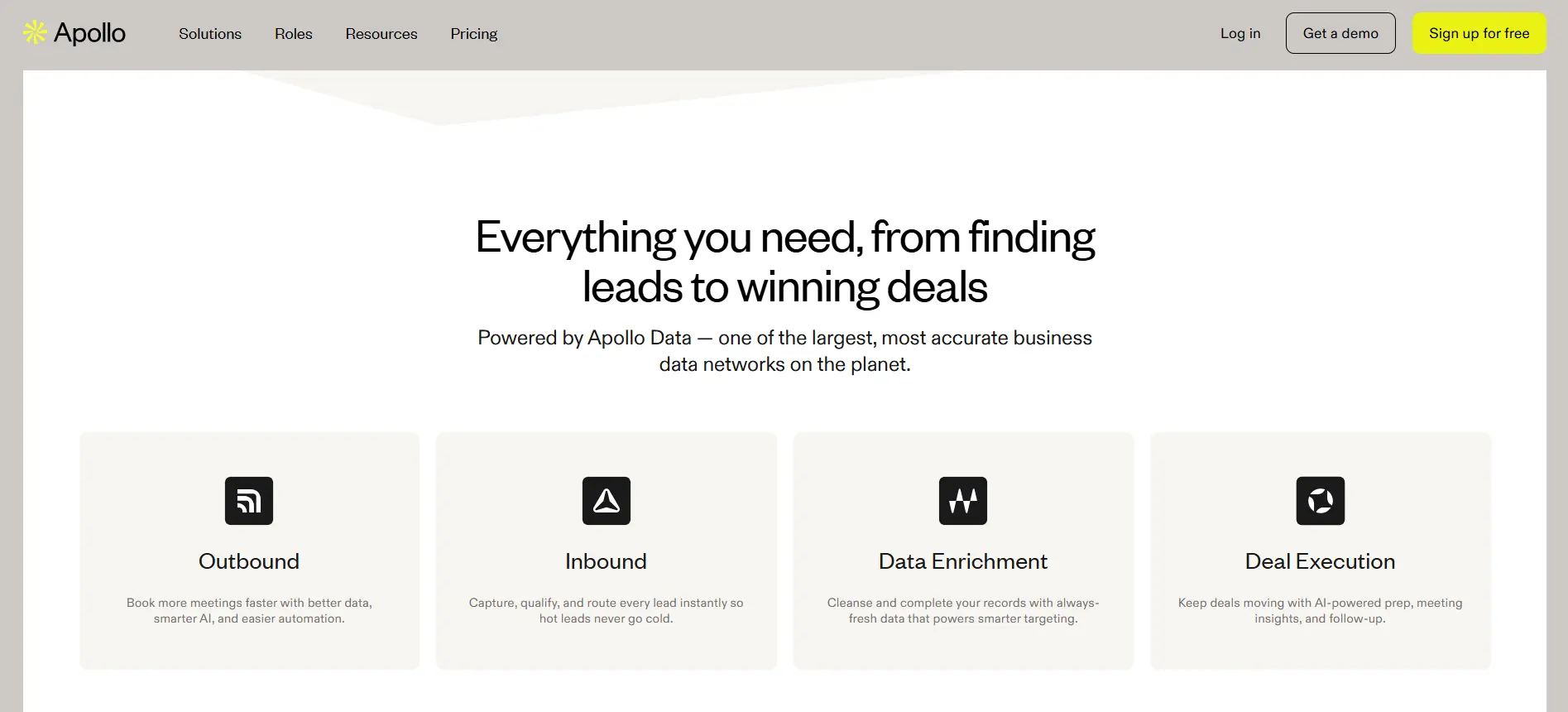
Apollo.io combines lead data with outbound execution. Reps can find prospects, send emails, and track engagement in one place.
AI helps prioritize leads based on signals and fit. This makes it easier for smaller teams to focus on high-potential accounts without complex setup.
CRM integrations exist, but are not as deep as enterprise tools.
Key Features:
- Lead database & discovery Find prospects using firmographic and role-based filters.
- Cold email automation Launch outbound campaigns directly from the lead list.
- Basic CRM syncing Pushes outreach activity into connected CRMs.
Pros:
- Cost-effective
- Scalable
Cons: Limited advanced CRM syncing.
Best For: Growing teams doing outbound sales
8. SalesLoft
SalesLoft emphasizes structured execution. It guides reps step by step through outreach workflows.
AI scores lead and conversations. Managers use this data for coaching instead of assumptions. Performance tracking is detailed and actionable.
The platform requires time to configure properly, but once set up, it supports consistent execution across teams.
Key Features:
- Guided sales engagement workflows Reps follow structured outreach paths across channels.
- AI-based lead and conversation scoring Prioritizes prospects and highlights coaching moments.
- Performance reporting dashboards Tracks rep activity and engagement quality.
Pros: Strong reporting
Cons: Learning curve
Best For: Teams running complex outreach programs
9. Reply.io
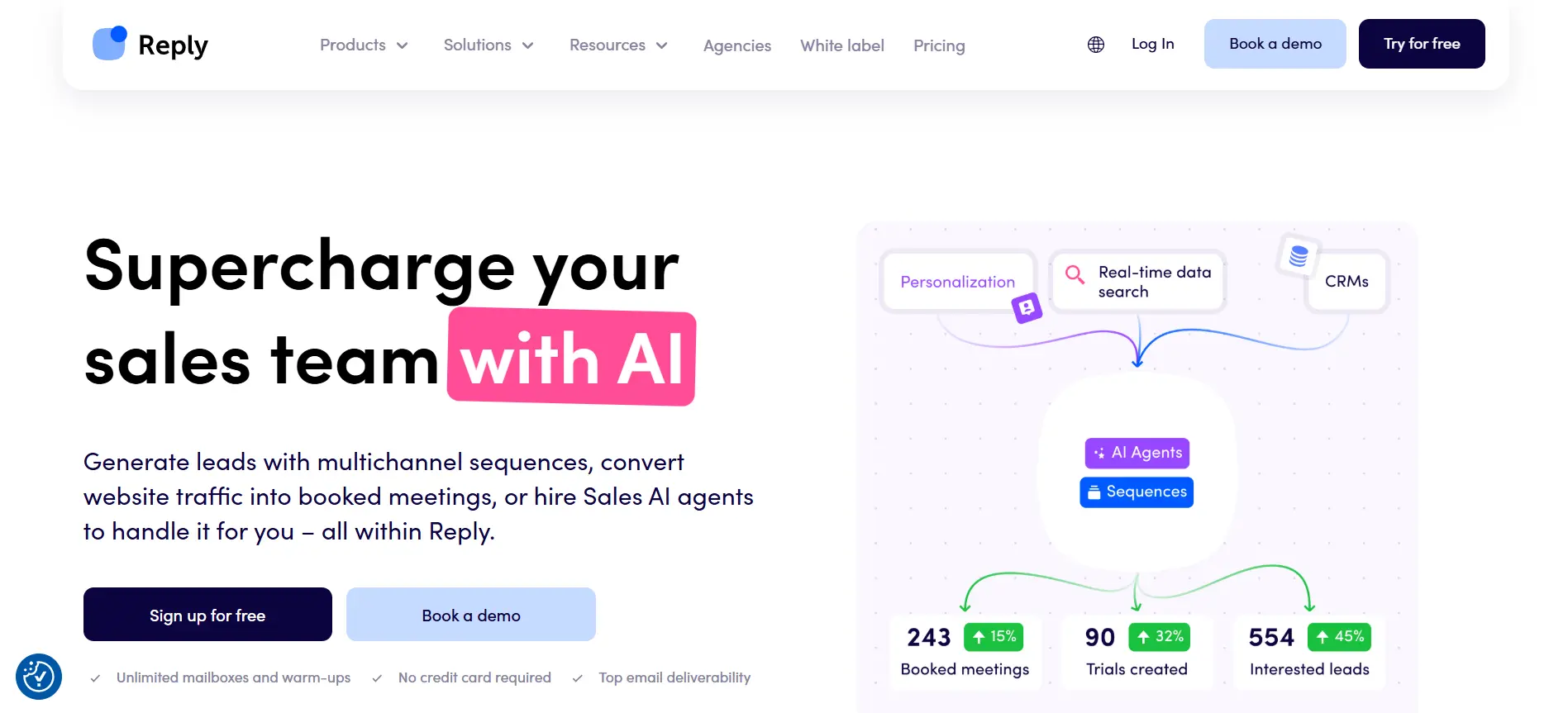
Reply.io is designed for automated outreach at scale. It focuses on cold emails and follow-ups with minimal setup.
AI optimizes sending times and sequences. Campaigns run smoothly without micromanagement. This makes it effective for teams prioritizing speed and volume.
It lacks deeper forecasting and analytics features but delivers fast execution.
Key Features:
- Automated cold email sequences Send follow-ups automatically until prospects reply.
- AI-optimized send timing Emails are delivered when prospects are most likely to respond.
- Reply and follow-up handling Keeps outreach running without manual intervention.
Pros:
- Simple
- fast to deploy
Cons: Limited advanced AI
Best For: Small teams focused on outbound volume
How to Choose the Right AI Sales Enablement Platform
After reviewing the tools, one question matters most. Which one actually fits how your team sells?
Choosing an AI Sales Enablement Platform is not about the longest feature list. It’s about alignment. A tool built for a 50-rep enterprise team can slow down a five-person startup.
The goal isn’t maximum automation. It’s useful automation.
Start by looking at how your team works today. How many reps are actively selling? How complex are your deals?
High-volume outbound teams need strong workflows and lead prioritization. Teams with longer sales cycles benefit more from forecasting and CRM depth.
Match the Platform to Team Size and Sales Motion
Small teams need speed. Simplicity matters more than configuration depth. A platform that takes months to set up will kill momentum.
Mid-size teams benefit from guided workflows. These keep execution consistent across reps. Larger teams need visibility across pipelines, territories, and performance.
For example, a startup doing outbound sales may need lead scoring and automated follow-ups. An enterprise team may care more about pipeline accuracy than outreach volume.
Prioritize CRM Integration Early
CRM integration should never be optional. Your AI Sales Enablement Platform must work inside your existing workflow.
If reps have to update data manually, adoption drops fast. Time gets wasted. Data quality suffers.
Look for platforms that sync emails, activities, and deal updates automatically. This keeps pipelines accurate and reporting reliable.
Focus on Automation That Reduces Real Work
Automation should remove friction. Not add more steps.
Avoid tools that automate everything but still need constant setup. Complexity slows teams down.
The right platform handles follow-ups, reminders, and lead routing quietly. Reps spend more time talking to buyers, not managing tools.
Balance Cost, Scalability, and Ease of Use
Cheap tools can get expensive if they don’t scale. Expensive tools waste money if features go unused.
Choose a platform that grows with your team. One that’s easy to adopt and easy to stick with.
Ease of use matters more than feature depth. If reps don’t use the tool daily, win rates won’t improve.
The right choice makes selling feel simpler. Not heavier.
Conclusion
Improving win rates starts with better execution, not more effort.
A strong AI Sales Enablement Platform helps sales teams focus on the right leads, automate follow-ups, and keep data accurate. This reduces manual work and improves consistency across the sales process.
If you’re exploring AI sales enablement to improve win rates, a practical next step is to see how an agentic approach works. Tools like Oppora.ai show how cold email can run end-to-end from lead discovery to booked meetings just by chatting with AI.
That’s a useful benchmark for what modern sales enablement should look like.
You can give Oppora a try for FREE. No Credit is required; you can either enjoy a 7-day free trial or keep on using the Free forever plan.
Frequently Asked Questions (FAQ)
What is an AI sales enablement platform?
An AI Sales Enablement Platform helps sales teams decide what to do next using data and automation. It supports lead scoring, follow-ups, content guidance, and CRM updates to improve focus and efficiency.
How does AI sales enablement improve win rates?
AI prioritizes high-intent leads and removes manual tasks. Reps spend more time on prospects likely to convert, which improves timing, relevance, and close rates.
What features matter most in an AI sales enablement platform?
The most important features are real-time lead scoring, workflow automation, CRM integration, and ease of use. These directly impact daily execution and adoption.
How is AI sales enablement different from a CRM?
A CRM stores sales data. An AI Sales Enablement Platform helps act on that data by guiding reps on who to contact, when to follow up, and what to do next.
How do I choose the right AI sales enablement platform?
Start with your team size and sales motion. Choose a platform that fits your workflow, integrates with your CRM, reduces manual work, and scales as your team grows.