12 Top AI Sales Agents: Types, Use Cases, and Examples
Sales have changed. Buyers expect instant replies, relevant messaging, and value before they ever speak to a human rep.
That shift has led to the rise of the AI sales agent — intelligent systems that handle repetitive, data-heavy sales tasks while enabling human reps to focus on closing.
But here’s the key:
Not all AI sales agents are the same. Some qualified leads. Some write outreach. Some analyze calls. Some forecast revenue.
The real advantage comes from knowing which type you need — and how they fit together.
Let’s break it down properly.
What Is an AI Sales Agent?
An AI sales agent is an AI-powered system designed to autonomously execute specific parts of the sales workflow — such as:
- Prospect identification
- Lead qualification
- Personalized outreach
- Follow-ups
- Call analysis
- Pipeline forecasting
Unlike traditional automation tools, modern sales AI agents:
- Use large language models (LLMs) for contextual messaging
- Learn from engagement data
- Adapt messaging tone and structure
- Prioritize leads based on intent signals
In simple terms: They don’t just automate. They analyze, decide, and act.
Types of AI Sales Agents (With Strategic Context)
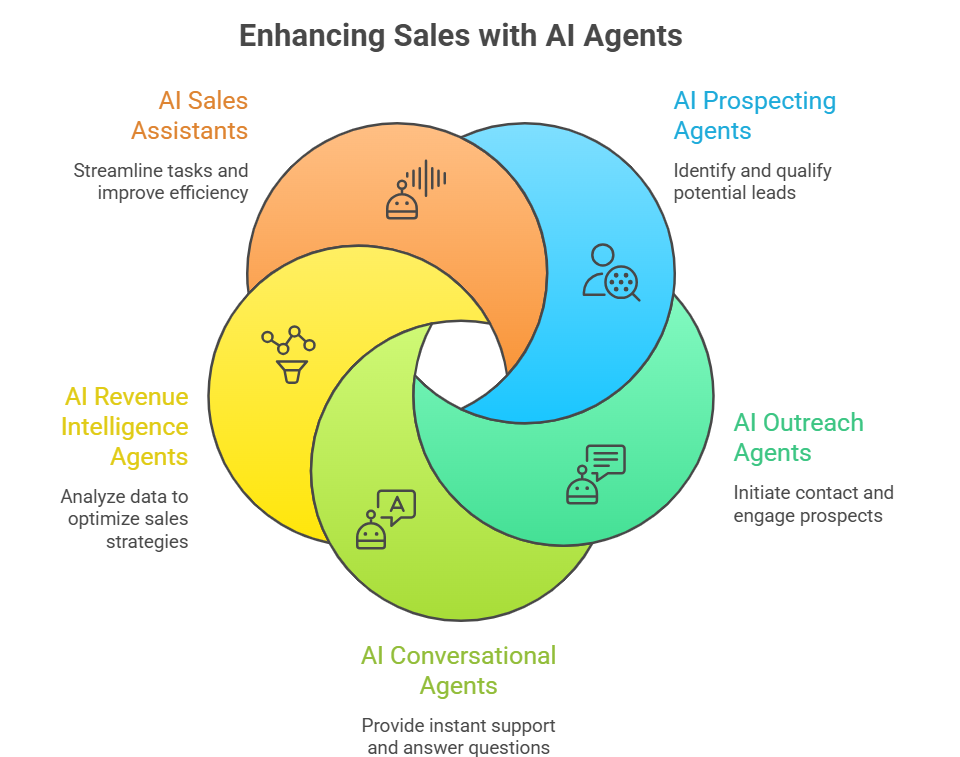
Before choosing the best AI sales agent, you need clarity on your bottleneck.
1. AI Prospecting Agents
These agents scan databases, LinkedIn profiles, firmographic data, and buying signals to identify high-fit accounts.
They reduce manual research time and improve ICP accuracy.
Best for: Outbound-heavy teams.
2. AI Outreach Agents
These are responsible for generating and sending hyper-personalized emails and LinkedIn messages at scale.
The difference between basic automation and real AI outreach?
Context.
For example, instead of:
“Hi, we help companies grow…”
An AI outreach agent references:
- Recent funding
- Hiring patterns
- Product launches
- Role-specific pain points
This is where platforms like Oppora.ai differentiate themselves — focusing on intelligent personalization rather than volume-based blasting.
3. AI Conversational Agents
Website chatbots powered by AI that:
- Qualify visitors
- Answer objections
- Book meetings
- Route enterprise leads
They reduce friction in inbound acquisition.
4. AI Revenue Intelligence Agents
These analyze calls, emails, and pipeline data to:
- Detect risk
- Identify winning talk tracks
- Improve close rates
- Predict revenue
Used more by scaling and enterprise teams.
5. AI Sales Assistants
Digital assistants that:
- Follow up automatically
- Re-engage cold leads
- Nurture prospects over time
These operate like autonomous SDRs.
12 Best AI Sales Agents (With Real Use Context)
Now let’s explore the most effective sales AI agents across categories.
1. Oppora.ai
Category: AI Outreach & Prospecting Agent
Best For: Personalized outbound at scale
Oppora.ai functions as an intelligent outbound AI sales agent built to solve one major problem in modern sales: generic outreach.
Instead of sending bulk sequences, Oppora focuses on relevance-first automation — combining prospect discovery, contextual analysis, and AI-generated personalization in one workflow.
Key Features
1. AI-Based Prospect Targeting Filters prospects based on ICP, role, industry, and company signals — reducing manual research.
2. Context-Aware Message Generation Analyzes prospect and company information to generate tailored outreach that references role-specific pain points and business context.
3. Hyper-Personalized Messaging Moves beyond name tokens and creates natural, conversational messages aligned with buyer intent.
4. Multi-Channel Outreach Supports structured LinkedIn and email sequences designed to feel progressive, not automated.
5. Intelligent Variations Generates different message angles and follow-ups to improve reply rates and avoid repetitive patterns.
Why It Stands Out
Most sales tools prioritize volume. Oppora prioritizes relevance and conversation quality.
For founders, SDRs, and B2B SaaS teams, this means:
- Higher reply rates
- Better first-touch engagement
- Less time spent on manual research
- Scalable personalization without increasing headcount
Example Use Case:
A B2B SaaS company targeting HR leaders uses Oppora to reference hiring trends and workforce challenges in outreach. Instead of increasing message volume, they improve contextual relevance — leading to more booked meetings and stronger conversations.
2. Salesforce (Einstein AI)
Category: Enterprise CRM Intelligence
Best For: Large teams managing complex pipelines
While some AI sales agents focus on outreach, Salesforce’s Einstein AI is built to optimize decision-making inside the CRM.
Einstein AI uses predictive modeling and machine learning to:
- Score leads based on conversion probability
- Forecast revenue with historical data patterns
- Identify at-risk deals before they stall
- Recommend “next best actions” for reps
Why It Matters
Enterprise sales teams deal with:
- Long sales cycles
- Multi-stakeholder deals
- Large datasets
Einstein AI analyzes CRM activity to surface insights humans might miss. It doesn’t send outreach — it improves strategic visibility.
Ideal Scenario: A 50+ member sales team needing pipeline accuracy and executive-level forecasting confidence.
3. HubSpot (AI Sales Tools)
Category: All-in-One AI CRM
Best For: SMB and mid-sized companies
HubSpot integrates AI directly into its CRM and sales suite. Rather than acting as a standalone AI sales agent, it embeds AI into everyday workflows.
AI capabilities include:
- AI-generated email drafts
- Predictive lead scoring
- Automated task recommendations
- Conversation summarization
- Sales forecasting
Strategic Advantage
HubSpot’s strength lies in usability. Teams don’t need multiple AI tools — they get built-in intelligence within one ecosystem.
Ideal Scenario: Growing companies that want AI assistance without building a complex tech stack.
4. Gong
Category: Revenue Intelligence AI
Best For: Improving close rates
Gong is not an outreach AI sales agent. Instead, it analyzes recorded sales calls, emails, and meetings.
Using AI, it identifies:
- Talk-to-listen ratios
- Objection patterns
- Competitor mentions
- Buying signals
- Winning conversation structures
Why It’s Powerful
Gong turns subjective coaching into data-driven improvement.
Instead of guessing why deals are lost, leaders can see patterns across hundreds of calls.
Ideal Scenario: Sales teams closing $10K+ ACV deals where conversation quality directly impacts win rates.
5. Outreach
Category: AI Sales Engagement
Best For: Structured outbound teams
Outreach combines automation with AI optimization. It helps sales reps manage sequences while AI analyzes:
- Send-time optimization
- Engagement trends
- Email performance
- Sequence effectiveness
Strategic Role
Outreach improves efficiency and performance tracking. However, message personalization often depends on user input unless paired with advanced AI writing tools.
Ideal Scenario: Teams running high-volume outbound campaigns that require sequence tracking and engagement analytics.
6. Apollo.io
Category: Prospecting + Outreach AI
Best For: Startups building outbound engines
Apollo.io combines:
- Large B2B contact database
- Email sequencing
- AI-assisted message generation
- Intent data
Its AI helps craft outreach copy and optimize engagement, but its main strength lies in data availability.
Strategic Positioning
Apollo is excellent for building prospect lists quickly. For teams prioritizing deeper personalization logic and contextual outreach, they often layer in specialized AI outreach tools.
Ideal Scenario: Early-stage startups need both data and outbound execution in one tool.
7. ZoomInfo
Category: AI Data Intelligence
Best For: Enterprise prospect targeting
ZoomInfo uses AI to:
- Detect buying intent signals
- Identify decision-makers
- Provide company-level insights
- Predict account readiness
Key Insight
ZoomInfo is primarily a data intelligence engine. It informs outbound strategy but doesn’t function as a conversational AI sales agent by itself.
It strengthens targeting accuracy — which directly impacts reply and conversion rates.
Ideal Scenario: Enterprise outbound teams require precise account-level targeting.
8. Drift
Category: Conversational AI Sales Agent
Best For: Inbound lead qualification
Drift’s AI-powered chat agents engage website visitors in real time.
They can:
- Ask qualifying questions
- Route high-value leads
- Book meetings instantly
- Reduce friction in scheduling
Why It Works
Speed increases conversions. The faster a visitor engages, the higher the likelihood of booking.
Drift eliminates wait time between interest and interaction.
Ideal Scenario: Companies generating significant website traffic and wanting immediate qualification.
9. Intercom
Category: AI Conversational Platform
Best For: Blending sales and support
Intercom uses AI to power chat experiences across:
- Sales qualification
- Customer support
- Product onboarding
Its AI can answer common questions, escalate to humans, and capture lead information.
Strategic Advantage
It bridges sales and customer experience — useful for SaaS businesses with high inbound inquiries.
10. Clari
Category: Revenue Forecasting AI
Best For: Predictable revenue growth
Clari focuses heavily on pipeline health and revenue forecasting.
Its AI:
- Analyzes pipeline movement
- Detects deal risk
- Predicts quarter outcomes
- Improves forecast accuracy
Unlike outreach AI, Clari works at the executive and RevOps level.
Ideal Scenario: Scaling companies focused on revenue predictability.
11. People.ai
Category: Activity Intelligence AI
Best For: Sales visibility and data hygiene
People.ai captures sales activity across emails, calls, and meetings automatically.
It helps organizations:
- Ensure CRM data accuracy
- Track rep productivity
- Identify performance gaps
Why It’s Important
Poor CRM hygiene leads to inaccurate forecasting.People.ai solves that foundational issue.
12. Conversica
Category: Autonomous AI Sales Assistant
Best For: Automated lead follow-ups
Conversica acts as a digital SDR.
It autonomously:
- Follows up with leads via email
- Nurtures cold prospects
- Engages inbound inquiries
- Hands off qualified leads to human reps
Strategic Use Case
Great for companies with large inbound databases where manual follow-ups are inconsistent.
Comparison Table: 12 Top AI Sales Agents (With Ratings)
Conclusion
AI sales agents are not one-size-fits-all. Each tool excels in a specific part of the sales workflow — from outbound personalization and lead qualification to revenue forecasting and call insights.
The biggest productivity gains come when you match the tool to your key bottleneck:
- 🟢 Need better outbound reply rates? Focus on AI outreach agents like Oppora.ai.
- 📈 Need stronger pipeline visibility or forecasting? Tools like Salesforce Einstein or Clari are ideal.
- 💬 Need stronger inbound qualification? Conversational AI tools like Drift and Intercom shine.
- 📞 Need to improve sales talk quality? Revenue intelligence platforms like Gong deliver actionable insights.
Among these, Oppora.ai stands out for outbound personalization at scale — especially for startups, SDR teams, and B2B SaaS companies looking to improve reply rates and conversation quality without doubling outreach volume.
In a world where buyers are overwhelmed by templated outreach, the teams that win will be the ones that:
✅ Use AI to work smarter, not just harder
✅ Personalize at scale
✅ Turn data into meaningful conversations
This is the real value of modern AI sales agents — and the path to stronger revenue performance in 2026 and beyond.
Frequently Asked Questions
Can AI sales agents replace human SDRs?
No — and they’re not meant to.
AI sales agents handle repetitive tasks like research, follow-ups, and message drafting. Human SDRs still lead discovery calls, build relationships, and close deals. The strongest results come from AI-human collaboration, not replacement.
Are AI sales agents compliant with email and LinkedIn policies?
Compliance depends on how the tool is used. Responsible AI outreach tools focus on personalization, controlled volume, and deliverability best practices to reduce spam risk and platform violations.
Is AI sales software suitable for small teams or only enterprises?
AI sales agents are increasingly valuable for small teams and founder-led sales. Startups benefit by scaling personalization without hiring multiple SDRs, while enterprises use AI for forecasting and intelligence at scale.
What is the best AI sales agent for startups or founder-led sales?
Startups typically benefit most from AI outreach and prospecting platforms like Oppora.ai, which focus on personalized outbound at scale without requiring a large sales team.