15 Cold Sales Email Templates for Higher Response
cold sales email cold email template for sales cold emailing for sales cold sales email sample how to write a cold email for sales best cold sales emails cold sales email examples best cold emails for sales
Most cold outreach fails before it even starts.
Your subject line gets ignored, your message feels generic, and your prospect moves on in seconds. That is not because cold email is dead. It is because most emails sound like pitches instead of conversations.
In this guide, you will get 15 practical cold sales email template examples you can use immediately. You will also learn why many campaigns struggle, how to structure emails that get replies, and how to scale outreach without losing personalization. By the end, you will know exactly how to write emails people actually respond to.
Why Most Cold Sales Email Campaigns Fail
If your outreach is not getting replies, the problem is rarely your offer.
It is usually how the message is framed, how it is opened, and how relevant it feels to the person reading it. Small mistakes compound quickly in cold emailing for sales, and even strong solutions get ignored.
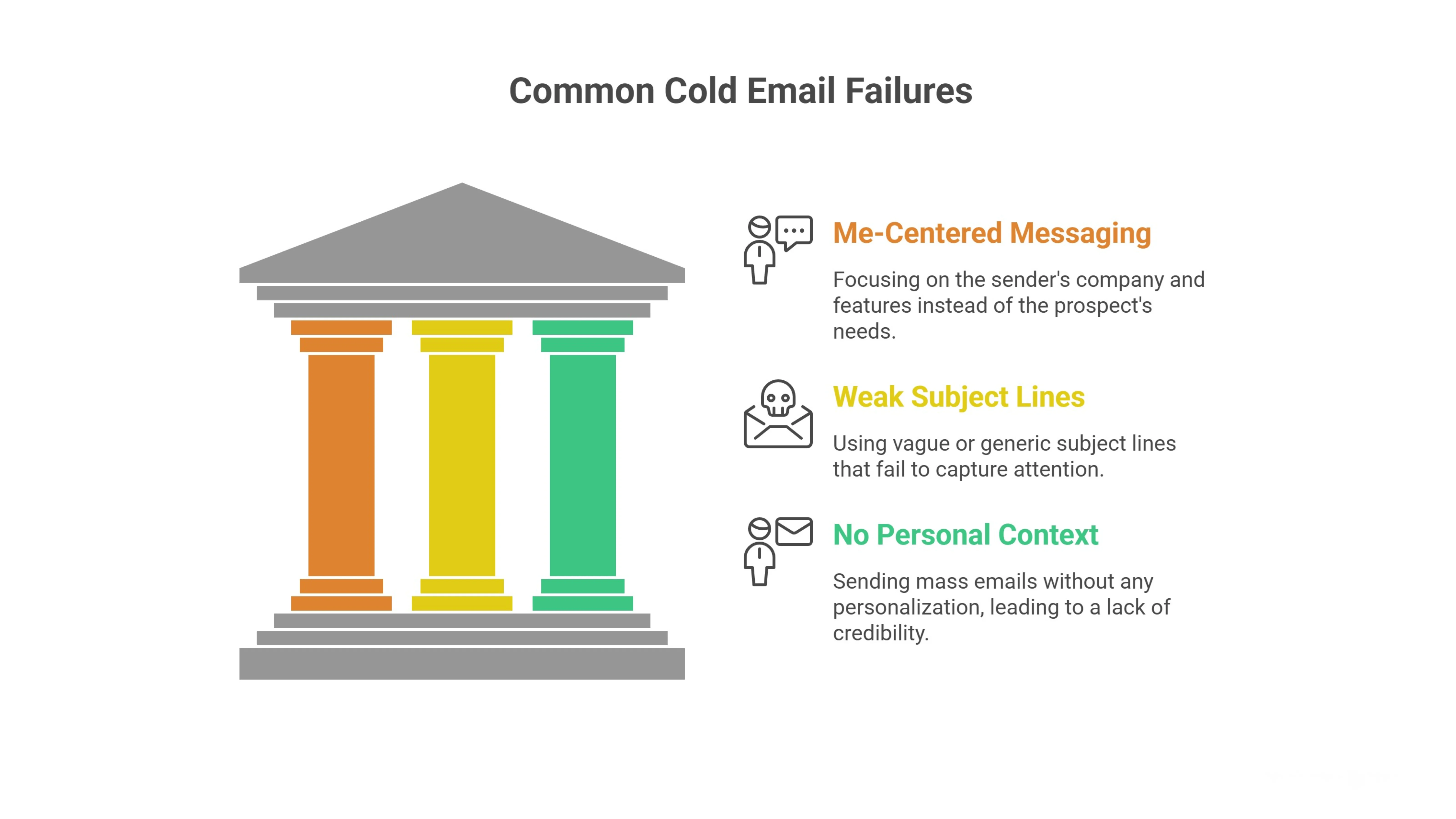
Let’s break down the three most common reasons campaigns fail.
Me-Centered Messaging Instead of Prospect Focus
Most cold sales email messages talk too much about the sender.
You explain your company, your features, your achievements, and your process before the prospect even understands why they should care. That instantly creates resistance.
When someone opens a cold email, they are subconsciously asking one question: “What’s in this for me?”
If your first few lines do not connect to their goals, challenges, or metrics, they will not continue reading. Strong outreach flips the focus. Instead of describing what you do, you highlight a problem they likely face and position yourself around that.
The shift from “we do” to “you may be dealing with” changes everything.
Weak or Generic Subject Lines
Even the best cold sales email will fail if it never gets opened.
Subject lines like “Quick intro” or “Opportunity for you” feel vague and promotional. They blend into crowded inboxes and get skipped without a second thought.
Short, specific, and relevant subject lines consistently perform better.
Clarity beats cleverness. Curiosity works when it feels natural. Hype almost never does.
No Personal Context
If your email looks mass-sent, it feels mass-ignored.
Prospects can instantly sense when they are part of a generic blast. Without context such as their role, industry trend, company milestone, or trigger event your message lacks credibility.
Even light personalization creates trust.
When your email feels intentional rather than automated, replies increase dramatically.
How to Write a Cold Sales Email Template That Gets Replies
Now that you know why most outreach fails, let’s fix the structure.
High-performing cold emails are not creative masterpieces. They are simple, focused, and easy to respond to. When you follow a clear framework, your cold email template for sales becomes repeatable and scalable without sounding robotic.
Here is the structure that consistently drives replies.
The 5-Part High-Response Structure
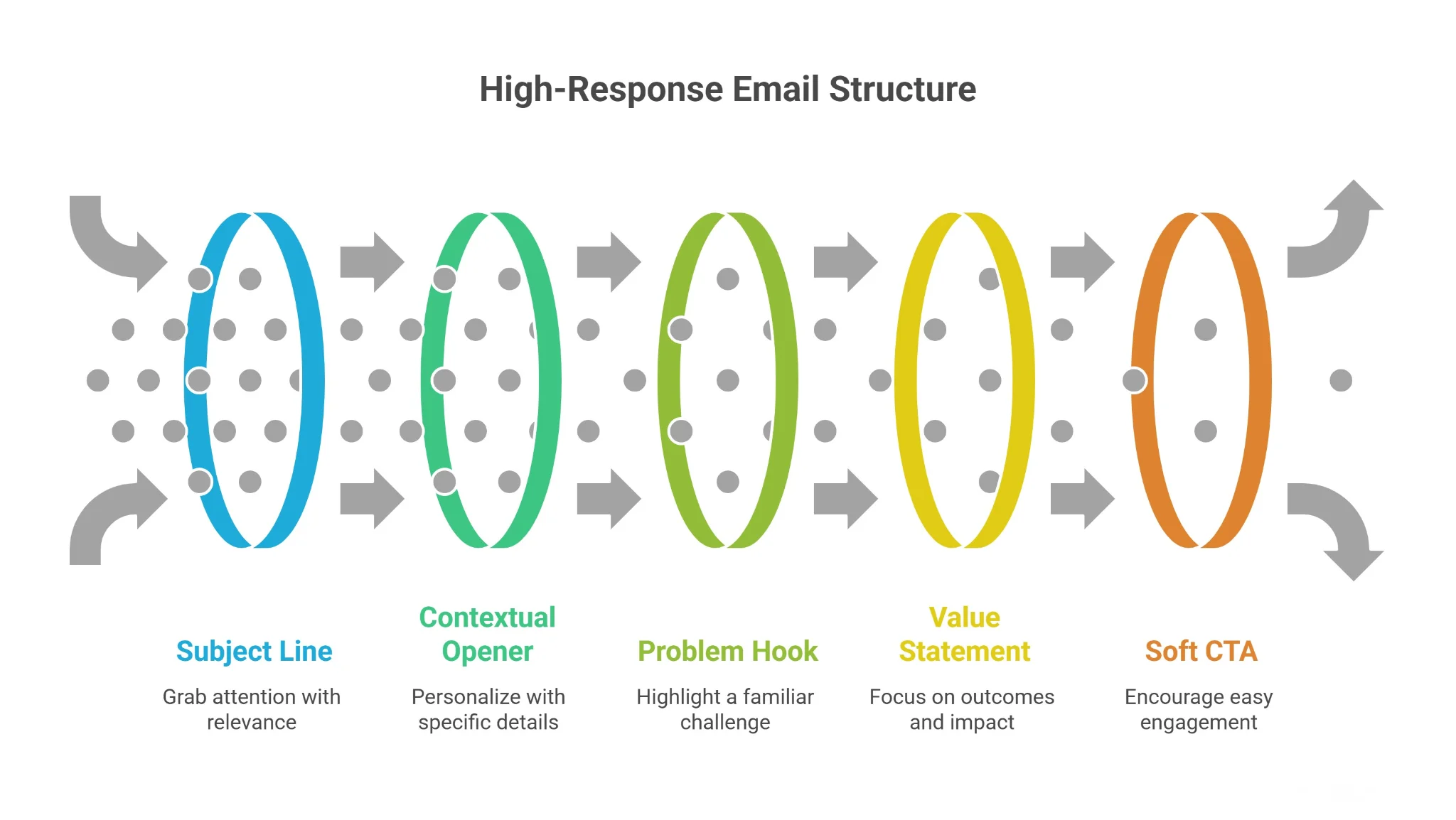
Most winning emails follow the same five-part flow: subject line, contextual opener, specific problem, outcome-focused value, and a low-pressure CTA. When each part stays tight and intentional, your message feels natural instead of pushy.
Subject Line
Your goal is not to sell in the subject line.
Your goal is to earn the open.
Keep it between three and six words. Make it relevant to their role, company, or challenge. Avoid promotional language or exaggerated claims.
Specific beats clever. Simple beats flashy.
Opening Line
The first sentence should prove this is not a mass blast.
Mention their role, a recent trigger event, an industry shift, or something specific about their company. Even one contextual detail signals effort.
This builds trust before you ever mention your offer.
Problem Hook
Next, highlight a challenge they likely face.
Keep it to one clear sentence that feels familiar and realistic. When your prospect reads it and thinks, “Yes, that’s accurate,” you have their attention.
Alignment always comes before persuasion.
Value Statement
Now introduce what you do — in one line.
Focus on outcomes, not features. Avoid explaining your full process. Instead, show the result you help create and why it matters to someone in their position.
Clarity increases confidence. Complexity creates doubt.
Soft CTA
End with a low-friction question.
Instead of pushing for a 30-minute demo, ask something easy to answer. “Worth exploring?” or “Open to a quick chat next week?” works because it feels optional.
The easier it is to reply, the more replies you will get.
15 Cold Sales Email Templates You Can Use Today
Now that you understand the structure, it is time to apply it.
Below, you will find 15 cold sales email examples built for real-world outreach scenarios. Each template includes a subject line, message body, and guidance on when to use it. These are not theoretical samples. They are practical starting points you can customize based on your audience, industry, and offer then test, refine, and scale with confidence.
1. The Quick Question Template
This template is built for simplicity.
Instead of explaining everything, you ask one direct question tied to a specific problem. It feels conversational, not promotional, which makes it easier for busy decision-makers to respond without overthinking.
Subject: Quick question about {{company}}
Body:
Hi {{Name}},
Are you currently exploring ways to improve {{specific problem}}?
We’ve helped similar teams simplify this without adding extra tools.
Worth a quick 10-minute chat?
Best,
{{Your Name}}
When to use: When reaching out to time-strapped leaders.
Best for: Founders, VPs, directors.
Why it works: A simple yes-or-no reply requires minimal effort.
2. The Problem-Focused Template
This template leads with a challenge your prospect likely faces.
Instead of introducing yourself first, you immediately highlight a pain point that slows growth or creates friction in their role. When the problem feels familiar, your message earns attention without needing a long explanation.
Subject: Struggling with {{problem}}?
Body:
Hi {{Name}},
Many {{industry}} teams find {{problem}} slows growth.We recently helped a similar company fix this in weeks.
Open to seeing how?
Looking forward,
{{Your Name}}
When to use: When the pain point is common and visible.
Best for: Ops, sales, or marketing leaders.
Why it works: Immediate relevance increases response likelihood.
3. The Social Proof Template
This template builds credibility by showing results from a similar company.
When prospects see that others like them achieved measurable outcomes, skepticism drops naturally. Instead of claiming you are effective, you demonstrate it with proof that feels relevant and believable.
Subject: How {{similar company}} improved {{metric}}
Body:
Hi {{Name}},
We helped {{company}} increase {{result}} by {{percentage}}.I believe {{your company}} may see similar gains.
Would it make sense to explore?
Happy to share more,
{{Your Name}}
When to use: When you have strong case studies or metrics.
Best for: Competitive or results-driven markets.
Why it works: Specific proof reduces risk and sparks curiosity.
4. The Direct Value Template
This template works when your value proposition is simple and outcome-driven.
Instead of building a long narrative, you clearly state the result you help achieve and invite a short conversation. When your offer is easy to understand, direct clarity often outperforms creative angles.
Subject: Reducing {{pain}} in 30 days
Body:
Hi {{Name}},
We help {{role}} reduce {{pain}} without adding complexity.
Would a short call next week be unreasonable?
Appreciate your time,
{{Your Name}}
When to use: When your solution delivers a clear, measurable outcome.
Best for: Straightforward B2B services.
Why it works: Clear benefits remove confusion and speed up decisions.
5. The Trigger Event Template
This template uses timing to your advantage.
When a company raises funding, hires aggressively, launches a product, or expands into a new market, new challenges usually follow. Referencing that event makes your outreach feel relevant instead of random.
Subject: Congrats on {{event}}
Body:
Hi {{Name}},
Saw you recently {{hired/expanded/launched}}.Many teams at this stage face {{challenge}}.
Worth discussing how to avoid it?
Congrats again,
{{Your Name}}
When to use: After visible company milestones.
Best for: Fast-growing startups and scaling teams.
Why it works: Event-based context increases relevance and reply rates.
6. The Curiosity Hook Template
This template creates interest without immediately pitching.
Instead of explaining everything upfront, you hint at an opportunity or insight related to their company. The goal is to spark enough curiosity that they reply asking for more details. When done right, it feels thoughtful rather than mysterious.
Subject: Quick thought
Body:
Hi {{Name}},
Noticed something interesting about {{company}}.Think there’s an opportunity to improve {{area}}.
Open to a short idea share?
Curious to hear your thoughts,
{{Your Name}}
When to use: Early-stage outreach or testing campaigns.
Best for: Top-of-funnel conversations.
Why it works: Curiosity encourages simple, low-effort replies.
7. The Data-Driven Template
This template uses numbers to make your message more credible.
Specific metrics feel concrete and believable, especially for performance-focused buyers who care about measurable outcomes. When you anchor your outreach around real data, your claim sounds less like a pitch and more like evidence.
Subject: {{Number}}% improvement idea
Body:
Hi {{Name}},
Companies similar to yours improved {{metric}} by {{number}}%.I’d love to show how this could apply to {{company}}.
Interested?
Open to sharing details,
{{Your Name}}
When to use: When you have clear performance data.
Best for: ROI-driven decision-makers.
Why it works: Numbers increase trust and reduce skepticism quickly.
8. The Referral Context Template
This template builds instant credibility through shared context.
When you mention a mutual contact, industry peer, or relevant introduction, your email feels warmer than a typical cold message. Even light referral context lowers resistance and increases trust from the first line.
Subject: Suggested we connect
Body:
Hi {{Name}},
{{Mutual contact/industry peer}} mentioned your team recently.
We’ve helped similar roles solve {{problem}} with measurable impact.
Open to connecting briefly?
Thanks,
{{Your Name}}
When to use: When you have a genuine connection or shared network.
Best for: Relationship-driven industries.
Why it works: Borrowed trust improves open and reply rates significantly.
9. The Permission-Based Template
This template lowers pressure by asking before pitching.
Instead of assuming interest, you respectfully check if the topic is relevant. That small shift changes the tone from persuasive to considerate, which works especially well in cautious or regulated industries.
Subject: Should I send details?
Body:
Hi {{Name}},
Not sure if this is relevant for you.
Would you like a short overview on how we help {{role}} with {{problem}}?
Let me know,
{{Your Name}}
When to use: When entering conservative markets.|
Best for: Finance, healthcare, legal, or enterprise buyers.
Why it works: Asking permission reduces friction and increases replies.
10. The Short and Bold Template
This template is designed for speed and volume.
It removes extra context and focuses only on the core value you provide. When testing new markets or validating messaging, shorter emails often outperform longer explanations because they require minimal reading time.
Subject: Fixing {{problem}}
Body:
Hi {{Name}},
We help {{industry}} solve {{problem}}.
Worth 10 minutes?
Thanks,
{{Your Name}}
When to use: During high-volume outbound testing.
Best for: Early-stage validation or broad targeting.
Why it works: Ultra-concise messaging lowers attention cost and increases quick replies.
11. The Personalized Insight Template
This template shows you did your homework.
Instead of sending a generic pitch, you reference a specific action, update, or initiative from their company. That small detail signals effort and makes your outreach feel intentional, especially for high-value accounts.
Subject: Noticed {{specific detail}}
Body:
Hi {{Name}},
Saw your team recently {{specific action}}.
Teams doing this often run into {{issue}}.
Happy to share a quick idea if helpful.
Happy to share ideas,
{{Your Name}}
When to use: When targeting strategic or enterprise prospects.
Best for: ABM campaigns and high-ticket offers.
Why it works: Demonstrated effort increases trust and response rates.
12. The Role-Specific Template
This template increases relevance by speaking directly to someone’s job function.
Instead of sending a broad message, you tailor the problem and outcome to the responsibilities tied to their role. When your email reflects what they are accountable for, it feels intentional and harder to ignore.
Subject: For {{role}} at {{company}}
Body:
Hi {{Name}},
Quick note for your role — many {{role}} teams struggle with {{problem}}.
We help reduce that with {{simple outcome}}.
Open to a quick chat?
Appreciate your perspective,
{{Your Name}}
When to use: When your ICP is clearly role-defined.
Best for: Department-level decision-makers.
Why it works: Clear targeting makes the email feel personal and relevant.
13. The Industry Angle Template
This template starts with a broader trend instead of a direct pitch.
By referencing a shift happening in their industry, you position yourself as someone paying attention to the bigger picture. It feels more like peer insight than sales outreach, which makes the conversation easier to start.
Subject: Seeing this in {{industry}}
Body:
Hi {{Name}},
Noticing more {{industry}} teams dealing with {{trend/problem}} lately.
We’ve helped reduce the impact with {{outcome}}.
Worth comparing notes?
Open to comparing notes,
{{Your Name}}
When to use: When clear industry trends are emerging.
Best for: Strategic buyers and leadership roles.
Why it works: Trend-based context creates relevance without sounding pushy.
14. The Comparison Template
This template creates contrast without sounding aggressive.
Instead of criticizing a competitor directly, you highlight the common approach teams use and point out a friction it often creates. Then you position your solution as a simpler or more efficient alternative.
Subject: Alternative to {{current approach}}
Body:
Hi {{Name}},
Many teams handle {{problem}} using {{tool/process}}, but it often leads to {{pain}}.
We offer a simpler path to {{outcome}}.
Open to a quick look?
Worth exploring,
{{Your Name}}
When to use: When a default tool or process dominates the market.
Best for: Tool-switching environments.
Why it works: Contrast sparks curiosity and invites reconsideration.
15. The Breakup Email Template
This template is designed to close the loop professionally.
Instead of continuing to follow up endlessly, you signal that you will step back. That subtle withdrawal often triggers responses from prospects who were interested but distracted. It creates a decision moment without pressure.
Subject: Should I close this?
Body:
Hi {{Name}},
Haven’t heard back, so I’ll pause outreach for now.If improving {{problem}} becomes a priority, feel free to reach out.
All the best,
{{Your Name}}
When to use: As the final step in a sequence.
Best for: Re-engaging silent prospects.
Why it works: Loss aversion encourages last-minute replies.
Automating Cold Sales Email Outreach with Oppora
Scaling outbound usually breaks when volume increases but quality drops.
Oppora keeps your cold email template for sales consistent, relevant, and scalable.
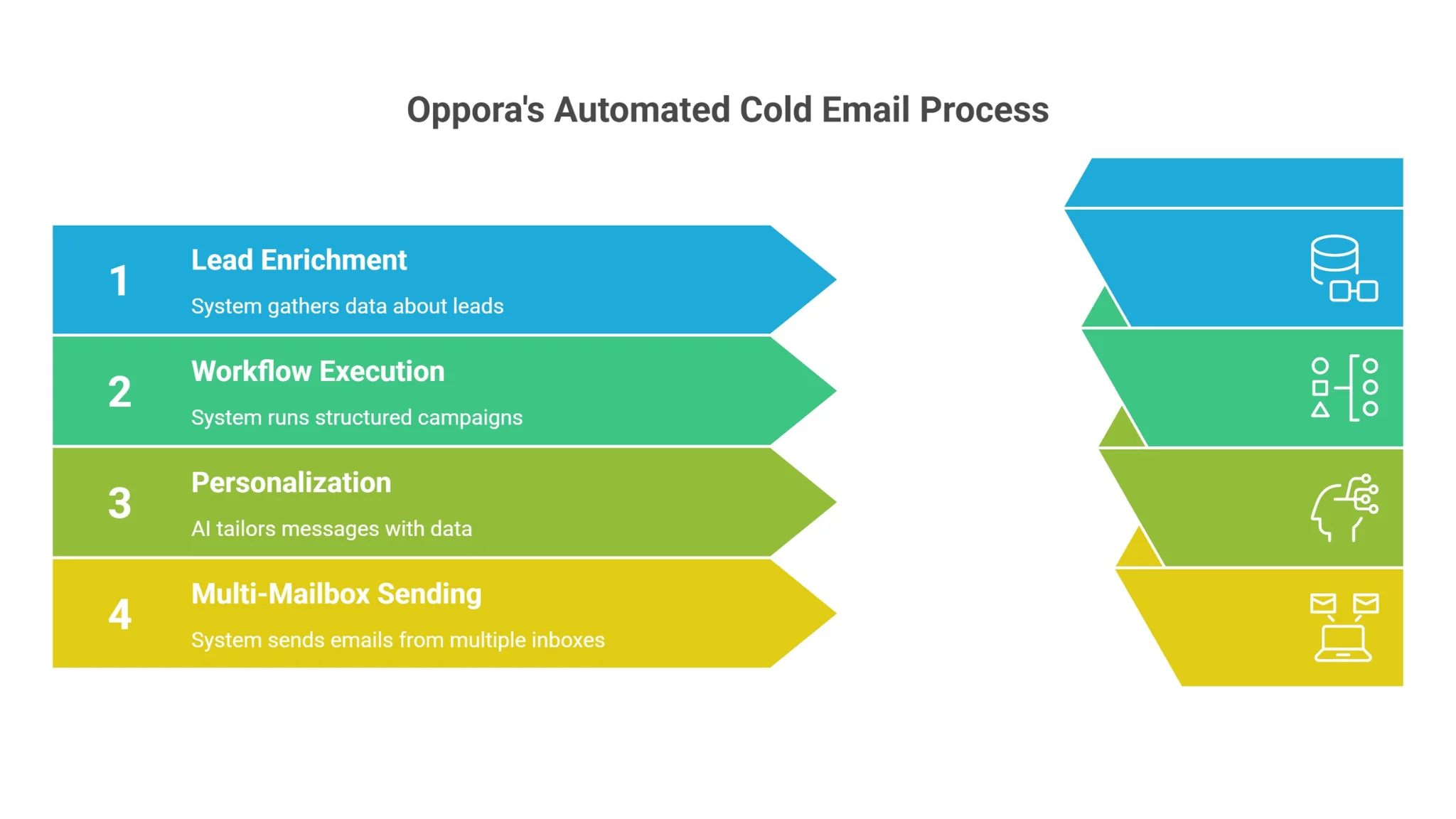
Instead of juggling tools, you run structured workflows hat handle lead search, enrichment, sending, replies, and CRM sync in one place .
You tell the system who you want to reach.
It builds and executes the workflow for you .
Clean. Predictable. Automated.
Build Structured Outreach Workflows
Create repeatable multi-step campaigns using Oppora’s workflow builder .
Define:
- Lead sourcing
- Enrichment
- Verification
- Sequences
- Follow-ups
No rebuilding from scratch every time.
Your cold email template for sales becomes a structured system — not a one-off experiment.
Consistency increases.
Manual effort drops.
Personalize with AI Variables
Use AI variables to tailor messaging with real prospect and company data .
Reference role, industry, hiring signals, or custom prompts dynamically.
No spintext.
No robotic filler lines.
Just relevant messaging at scale.
Scale with Multi-Mailbox Sending
Connect multiple inboxes and warm them automatically.
Distribute volume safely.
Protect sender reputation.
Control pacing as you grow.
More emails sent.
Same message quality.
That’s how you scale outbound without breaking it.
Conclusion
The best cold sales emails are short, relevant, and easy to respond to.
When you focus on the prospect, keep your structure tight, and remove friction from your CTA, replies become more predictable. These 15 templates give you a starting point. Testing, refining, and segmenting will help you improve results over time.
And if you want your outreach to run consistently without manual follow-ups, tools like Oppora can help you turn these templates into structured, automated workflows. If scaling outbound is your next step, it may be worth exploring how it fits into your process.
Frequently Asked Questions (FAQs)
How many follow-ups should I send in a cold email sequence?
Most campaigns perform best with 3–5 touchpoints spread over 10–14 days. Fewer emails may limit opportunities, while too many can feel aggressive. Space them thoughtfully and add value in each follow-up rather than repeating the same message.
What is a good reply rate for cold sales emails?
Reply rates typically range between 5% and 15%, depending on targeting, offer clarity, and deliverability. Highly personalized campaigns aimed at niche audiences can exceed this range. Focus on qualified replies, not just total responses, to measure true performance.
How do I test which template works best?
Run A/B tests with small variations in subject lines, problem hooks, or CTAs. Change one variable at a time so you know what influenced results. Measure open rates, reply rates, and positive responses before scaling the winning version.
Should I use HTML or plain text for cold emails?
Plain text usually performs better for cold outreach. It feels more personal and avoids promotional formatting that can trigger spam filters. Keep formatting simple, conversational, and free from heavy links or images in initial emails.
How long should a cold sales email be?
Aim for 50–125 words. Your email should be short enough to read in under 30 seconds. Remove unnecessary explanations and focus on one problem, one outcome, and one simple question that makes replying easy.