How to Automate Your Sales Process in 5 Minutes
Learn how to automate your sales process in minutes using a connected workflow. This guide breaks down lead capture, outreach, replies, and CRM updates with real, practical examples.

Most B2B founders and small sales teams don’t struggle with selling — they struggle with everything around selling.
Finding leads, verifying emails, sending follow‑ups, replying on time, and updating CRMs quietly eats hours every week — in fact, studies show sales reps spend over 30% of their time on these manual tasks. That’s where sales process automation comes in, helping teams reclaim hours each day and focus on conversations that actually drive revenue.
With the right workflow, you can automate your sales process in under 5 minutes and let the system handle repetitive work while you focus on conversations.
This guide shows exactly how a modern automated sales process works, step by step using real workflows, not just the theory.
What Is Sales Process Automation? (Expanded Explanation)
Sales process automation is the use of software to systematically handle repetitive, rule-based sales activities so they run without constant human input.
In a traditional sales setup, reps manually push leads from one step to the next — researching prospects, deciding who to contact, sending emails, following up, replying, and updating the CRM. This creates delays, inconsistency, and missed opportunities.
With an automated sales process, those steps are connected into a single, continuous workflow. Each action triggers the next automatically:
Find leads → score them → send outreach → handle replies → book meetings → sync CRM
What makes sales automation effective is connection, not just automation. Lead data flows forward without manual handoffs. Outreach doesn’t pause waiting for someone to click “send.” Replies are handled based on intent, not availability.
When done right, sales process automation:
- Ensures no lead is forgotten
- Reduces response time dramatically
- Keeps messaging consistent
- Removes manual admin work
- Creates a predictable, repeatable sales system
Importantly, sales automation does not replace human sellers. It replaces the manual friction around selling. Humans still handle strategy, conversations, and closing — but the system takes care of everything that slows them down.
This is why modern teams use sales automation not to “send more emails,” but to run sales as a process instead of a set of tasks.
Let’s see the differences in one glance
Manual vs Automated Sales Process
Why Most Sales Automation Fails
Many teams try automating sales and give up. The reasons are predictable:
- Tools automate tasks, not the entire sales automation process
- Too many disconnected tools
- Generic templates that hurt reply rates
- No visibility into what happens after sending
True sales automation process flow works only when everything is connected — from lead capture to reply handling.
That’s why modern teams focus on workflow‑based automation instead of isolated features.
Modern Sales Automation Process Flow (Step‑by‑Step)
Below is a practical breakdown of how teams automate their sales process today.
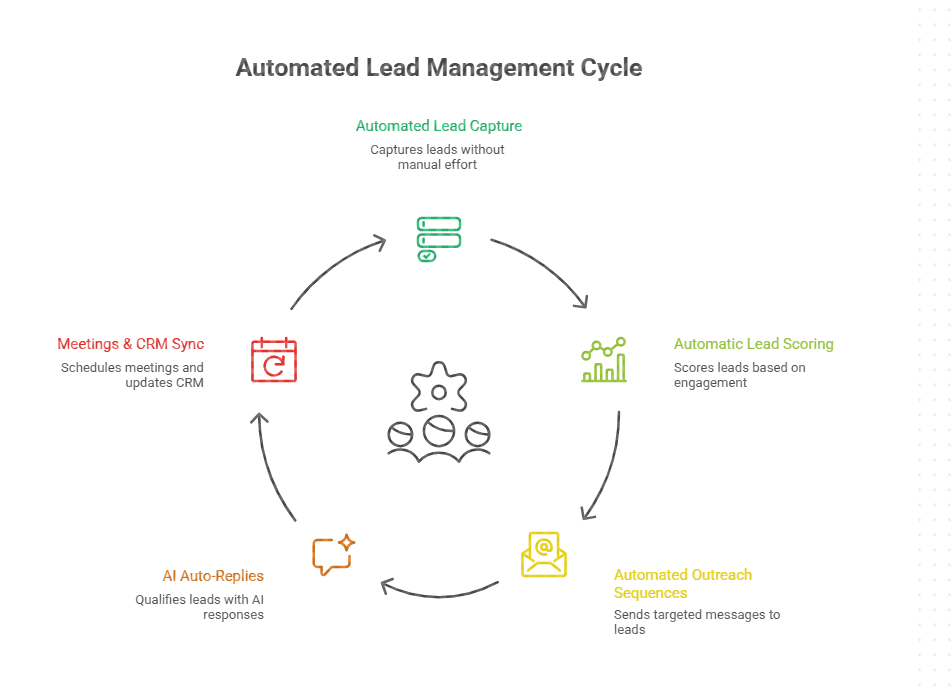
Step 1: Automated Lead Capture (No Manual Searching)
The first step in automating your sales process is removing manual lead research.
Instead of exporting CSVs or scraping profiles, automated systems continuously find leads based on filters like:
- Job title
- Industry
- Company size
- Location
Example: A SaaS founder targeting HR managers at 50–200 employee companies sets filters once. New matching leads are added automatically.
Step 2: Automatic Lead Scoring
Not every lead deserves outreach. That’s why the sales automation process includes lead scoring.
Automated lead scoring ranks prospects based on relevance and fit, helping you:
- Focus on high‑intent leads
- Improve reply rates
- Reduce spam risk
Instead of guessing, the system prioritizes who should be contacted first.
Step 3: Automated Outreach Sequences
Outreach isn’t one email. A real automated sales process includes follow‑ups.
Automation handles:
- Initial email
- Follow‑ups
- Timing and throttling
Once configured, campaigns run without daily monitoring.
Example: An agency sets a 5‑step sequence once. The system sends emails and follow‑ups automatically for every new lead.
Step 4: AI Auto‑Replies That Qualify Leads
Most tools stop after sending emails. That’s where sales automation usually breaks. Advanced sales process automation continues after replies arrive.
AI auto‑replies can:
- Read incoming responses
- Answer basic questions
- Classify interest (interested / not interested)
- Share meeting links
Real scenario: A prospect replies “Can you share more details?” The system responds instantly instead of waiting hours.
Step 5: Meetings & CRM Sync (Fully Automated)
The final step is removing admin work.
Automation:
- Books meetings automatically
- Updates CRM records
- Tracks replies and outcomes
Sales teams focus only on qualified conversations.
How to Automate Your Sales Process in 5 Minutes With Oppora.ai
This is where teams stop talking about automation and start using it end to end.
Instead of stitching together lead tools, email tools, CRMs, and follow‑up reminders, Oppora lets you set up a complete sales workflow in minutes. You’re not configuring every step manually — you’re approving a system that’s designed to keep running on its own.
Below is what a real, practical setup looks like inside Oppora.
Step 1: Describe Who You Sell To
Oppora.ai starts with intent, not configuration.
Instead of manually selecting dozens of filters or uploading lead lists, you describe “who you want to reach”. This becomes the instruction Oppora’s AI Planner uses to build the workflow.
You define:
- What you sell
- Who you want to reach
- Any constraints (location, company size, role)
Example input: “Find HR managers at 50–200 employee SaaS companies in the US that are actively hiring.”
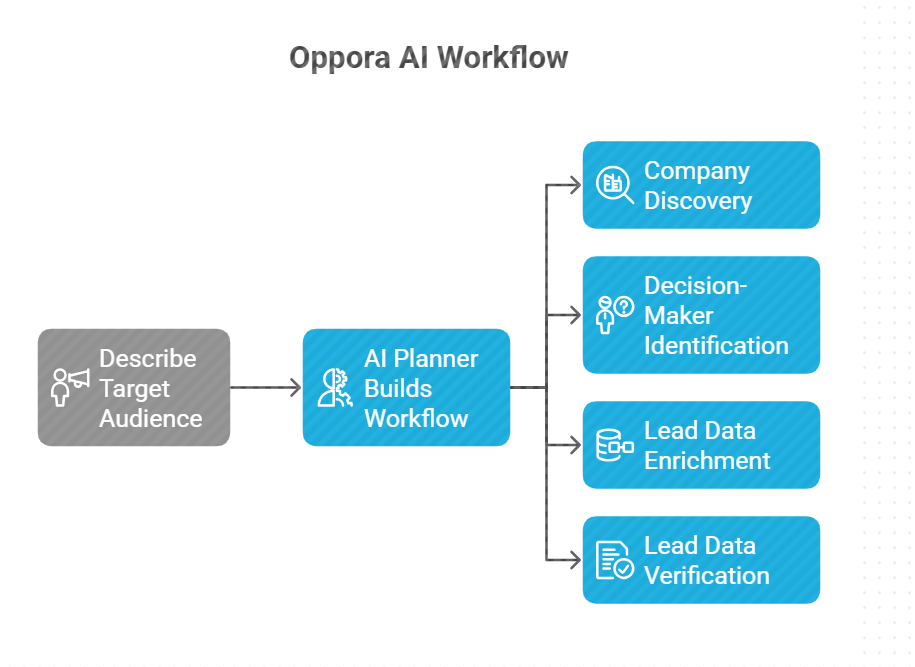
Oppora.ai converts this into structured logic for company discovery, lead sourcing, enrichment, and outreach — automatically.
What happens behind the scenes:
- Companies matching the description are discovered
- Decision‑makers are identified
- Lead data is enriched and verified
Step 2: Review the Auto‑Generated Sales Workflow
Once the instruction is submitted, Oppora.ai generates a complete, connected sales workflow.
Instead of separate tools, you see one visual flow that includes:
- Company discovery and filtering
- Lead identification and enrichment
- Email verification
- Outreach sequence creation
Each step feeds into the next. There are no manual hand‑offs.
At this stage, your job isn’t to build the workflow — it’s to review and confirm it matches your intent.
Step 3: Approve Leads and Messaging
Before anything is sent, Oppora pauses for human approval.
You can:
- Preview real leads the system found
- See how leads are scored and prioritized
- Review email copy and follow‑ups generated for the campaign
- Adjust tone, positioning, or exclusions if needed
This ensures automation runs with oversight — not blindly.
Step 4: Launch the Campaign
Once approved, you launch the workflow.
From this point on, the system runs continuously:
- New matching leads are added automatically
- Emails are sent based on timing and deliverability rules
- Follow‑ups go out without reminders or manual triggers
You don’t restart campaigns or rebuild sequences. The workflow stays active and adapts as new leads enter.
Step 5: Monitor Replies in One Inbox
Automation doesn’t stop at sending.
All replies across inboxes appear in a single, shared view. Oppora.ai reads responses, classifies intent, and takes action based on what the prospect says.
The system can:
- Identify interested vs non‑interested replies
- Send contextual AI replies when appropriate
- Share meeting links automatically
- Sync outcomes to your CRM
Your role shifts from chasing replies to handling qualified conversations.
Ready to Run This Workflow Yourself?
You’ve seen the full setup — from defining your ICP to handling replies in one inbox.
If you want to run this exact workflow with your own leads, domains, and inboxes, you can do it right now.
👉 Log in to Oppora.ai and launch your first automated sales workflow in minutes. No setup maze. No disconnected tools. Just describe who you want to reach and let the system run.
Get started here: Login | Oppora
Final Thoughts
Sales automation isn’t about speed. It’s about focus.
A well‑designed sales automation process flow removes busywork and lets teams spend time on conversations that matter.
The key takeaway is simple: when your sales workflow is connected end to end, automation removes friction without removing control, allowing teams to focus on conversations, not coordination.
FAQ’s
How does Oppora.ai replace multiple sales tools with one workflow?
Oppora combines lead sourcing, email sequencing, CRM updates, and follow-ups into one adaptive workflow, cutting setup time and complexity.
Can non-technical teams launch automated campaigns in Oppora?
Yes. Users give simple instructions, review the workflow, and Oppora handles lead discovery, outreach, replies, and CRM updates automatically.
Why do most sales automation setups fail, and how to avoid it?
Isolated task automation causes disconnected workflows and missed leads. True automation connects lead capture, outreach, replies, and CRM updates in one continuous system.
How quickly can a small team implement a fully automated workflow?
Even a solo founder can launch a complete automated campaign in minutes, with Oppora handling leads, outreach, responses, and CRM updates continuously.