How to Combine LinkedIn Outreach with Email Campaigns
Most outbound teams don’t struggle with effort — they struggle with coordination.
LinkedIn messages go out. Email campaigns run. But the two rarely work together in a structured way. Prospects see disconnected touches, reps duplicate work, and reply rates stall.
Today’s buyers don’t live in a single channel.
They notice you on LinkedIn, skim your email later, and often respond only after multiple familiar touchpoints. That’s why relying on just one outbound channel is becoming less effective.
The real advantage comes from knowing how to combine LinkedIn outreach with email campaigns so each touch builds on the last instead of repeating it.
When the sequence is aligned:
- LinkedIn creates familiarity
- Email adds context and credibility
- Follow-ups feel intentional instead of pushy
This guide breaks down exactly how to structure that motion — in a way that stays human, scalable, and practical for real outbound teams.
Why LinkedIn + Email Works Better Together
Think of outbound like meeting someone at a conference.
- LinkedIn = walking up and introducing yourself
- Email = the follow-up conversation
- Both together = a real relationship
When used together correctly:
- LinkedIn builds familiarity and trust
- Email provides depth and credibility
- Multi-channel increases reply rates significantly
- Prospects see you multiple times (without feeling spammed)
The key insight: buyers rarely respond on the first touch. Multi-channel simply increases your surface area.
But most teams combine them poorly. Let’s fix that.
The Core Problem Most Teams Face
Before jumping into tactics, understand where things usually break.
❌ Common mistakes
- Sending LinkedIn and email on the same day
- Using identical copy on both channels
- Not tracking who saw what
- Over-automating LinkedIn (hurts deliverability and trust)
- Manual list management across tools
- Inbox chaos when replies start coming in
The result? Fragmented outreach that feels robotic.
What you need instead is a coordinated sequence that feels human.
The Simple Framework
Let’s explain this simply.
Your outreach should follow this rhythm:
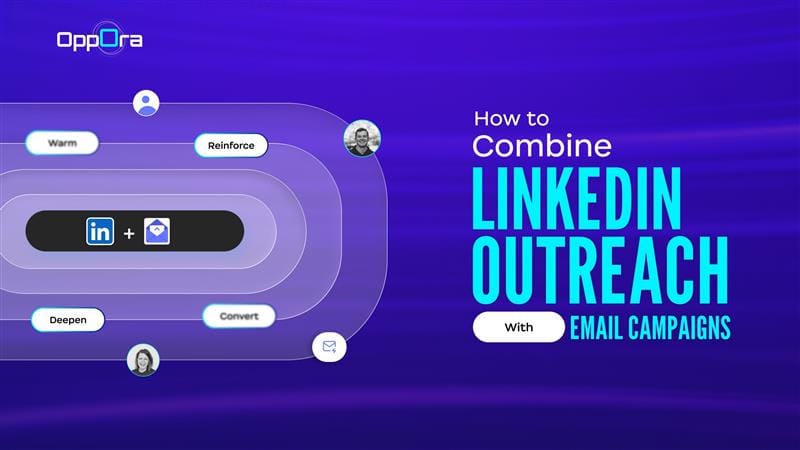
Warm → Reinforce → Deepen → Convert
Each channel plays a specific role.
If you remember only one thing from this article, remember this flow.
Step-by-Step: How to Combine LinkedIn Outreach with Email Campaigns
Step 1: Start with Signal-Based Prospecting
Don’t begin with random lists.
High-performing teams start with buying signals, such as:
- Hiring for relevant roles
- Recent funding
- Tech stack changes
- Leadership hires
- Company growth indicators
Why this matters:
If timing is wrong, even perfect messaging fails.
Step 2: Warm the Prospect on LinkedIn First
Before emailing, create light awareness.
Recommended sequence:
Day 0
- View profile
- Follow (optional)
- Send connection request with short note
Good connection note:
“Hi {{Name}} — came across your work in {{area}}. It would be great to connect.”
Keep it simple. This is not the pitch.
Goal: familiarity, not conversion.
Step 3: Send the First Email After the Warm-Up
Once the connection request is accepted (or after 2–3 days), send your first email.
Why email now works better:
- Your name feels familiar
- Trust barrier is lower
- Open rates improve
- Replies improve
Email objective: introduce the problem you solve.
Not to book the meeting immediately.
Step 4: Use LinkedIn for Light Engagement
After the first email, return to LinkedIn.
Good LinkedIn touches:
- Like a recent post
- Comment meaningfully
- Send a short follow-up message
Example LinkedIn message:
“Curious — is improving {{specific outcome}} a priority this quarter?”
Short. Conversational. Non-salesy.
Step 5: Continue Email Follow-Ups for Depth
Email is where real persuasion happens.
Use it for:
- Case studies
- Specific outcomes
- Numbers and proof
- Clear CTAs
Channel roles to remember:
- LinkedIn → conversation starter
- Email → credibility builder
- Both → meeting driver
Step 6: Synchronize Timing (Most Overlooked Step)
This is where most teams fail.
Bad timing looks like:
❌ LinkedIn message and email same day
❌ Five touches in three days
❌ Long gaps that kill momentum
Better cadence example:
- Day 0: LinkedIn connect
- Day 2: Email #1
- Day 5: LinkedIn message
- Day 8: Email #2
- Day 14: Email #3
- Day 18: LinkedIn follow-up
Spacing creates natural exposure.
How to Keep Messaging Consistent Across Channels
Your prospect should feel:
“This person understands my problem.”
Not:
“I’m being blasted by automation.”
Use Message Layering
Each touch should add something new.
Don’t repeat. Progress.
Example progression:
- Problem awareness
- Specific pain
- Proof
- Objection handling
- Soft close
Think of it as chapters in a story.
Where Teams Struggle Operationally
At a small scale, this is manageable.
At scale, things break:
- Lists get messy
- Reps duplicate prospects
- Replies get buried
- Manual tagging eats time
- Follow-ups slip through cracks
- Multi-channel visibility disappears
This is the exact point where tooling starts to matter.
As teams start combining LinkedIn outreach with email campaigns at higher volume, the biggest bottleneck usually shifts from strategy to execution — especially on the email side where follow-ups, deliverability, and reply management quickly become difficult to handle manually.
Supporting the Email Side of Your LinkedIn and Email Strategy
While LinkedIn helps create familiarity, email is where most of the real outbound workload lives — building prospect lists, finding verified emails, sending sequences, and managing replies at scale.
This is where many teams start to feel operational drag.
Manually juggling spreadsheets, multiple inboxes, and follow-up schedules can slow down even well-designed multi-channel campaigns. As volume grows, small gaps — missed replies, poor deliverability, inconsistent follow-ups — begin to compound.
Platforms like Oppora are built to support this exact layer of outbound execution. Instead of replacing your LinkedIn motion, it strengthens the email side by helping teams:
- Find verified emails of decision-makers
- Build outreach-ready lead lists
- Run personalized email sequences
- Handle mailbox warm-up and rotation
- Automatically tag replies (interested, wrong person, meeting booked)
When your LinkedIn warming is already creating recognition, having the email engine run smoothly in the background makes the overall motion far more consistent and scalable.
For teams serious about combining LinkedIn outreach with email campaigns, tightening the email execution layer is often what turns a good outbound strategy into a repeatable one.
Final Thoughts
Combining LinkedIn outreach with email campaigns isn’t about adding more volume — it’s about creating coordinated momentum.
When both channels work together:
- Prospects recognize your name sooner
- Trust builds across multiple touchpoints
- Follow-ups feel intentional instead of automated
- Reply rates become more predictable
Start with a simple sequence. Focus on timing and message progression. Then, as volume grows, strengthen the operational side so nothing slips through the cracks.
Teams that treat LinkedIn and email as one connected motion — rather than two separate activities — are the ones that consistently turn outbound into a reliable pipeline channel.