How to End an Email Without Sounding Awkward or Rude
Master email closings with examples, templates, and tips to leave a great impression every time.
Ever typed out a thoughtful email… then froze at the last line? That tiny space at the bottom of your email — your closing — can make a huge difference. It can either invite a reply, leave a lasting impression, or… quietly make your email disappear into the void.
Ending an email correctly isn’t just etiquette; it’s strategy. Here’s your deep dive into how to end an email without sounding awkward, rude, or robotic, complete with examples, templates, and actionable tips.
Why Email Endings Matter More Than You Think
People often focus on the greeting, the tone, and the ask — but the ending is a subtle behavioral cue that influences whether someone responds.
For example:📊 Emails that use a polite closing like “Kind regards” or “Thank you” see up to 36% more responses than emails without thoughtful sign-offs.📊 Another survey found that ending with a form of “thank you” increases reply rates by 63–65% compared to generic closings like “Best.”
💡 The takeaway: endings aren’t optional extras — they can make or break engagement. A poorly thought-out closing can erase all the effort you put into the body of your email.
What to Include at the End of Your Emails
A strong email ending isn’t just a sign-off. Think of it as a mini-conversation finale — wrapping up your main message while prompting action or leaving a positive impression. Here’s what it should include:
1️⃣ A Thoughtful Closing Line
This is your final sentence before the sign-off. It connects the main content of your email to your ending and can serve several purposes:
- Express gratitude: “Thank you for taking the time to review this.”
- Invite engagement: “I’d love to hear your thoughts on this proposal.”
- Call-to-action: “Would you be available for a 15-minute call next week?”
- Set expectations: “I’ll follow up next week if I don’t hear from you.”
Example:
Hi Priya,
Here’s the proposal we discussed. I’d love your feedback and am happy to schedule a call to walk through any questions.
Looking forward to hearing from you!
Notice how the closing line is polite, actionable, and leaves the reader with a next step — it’s not vague or robotic.
2️⃣ Choosing the Right Sign-Off
Your sign-off phrase sets the tone for your entire email. The wrong choice can make your email feel awkward, cold, or overly casual.
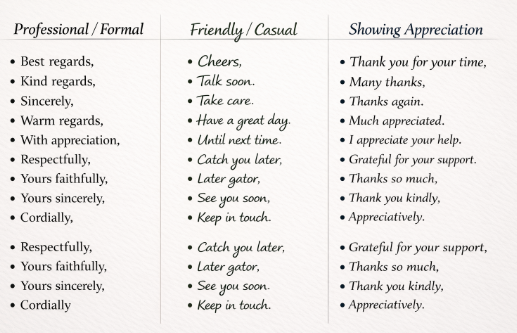
- Professional / Neutral: Best regards, Kind regards, Warm regards
- Friendly & Engaging: Best wishes, All the best, Looking forward to your reply
- Appreciative / Thankful: Thank you, Many thanks, Thanks again
- Casual / Internal: Talk soon, Cheers, Take care
💡 Pro tip: When in doubt, go formal first. You can loosen the tone in follow-ups once the relationship develops.
3️⃣ State Your Name Clearly
Include your full name when emailing someone for the first time. For internal emails or familiar contacts, your first name is sufficient. Avoid nicknames unless they’re widely known.
Example:
Warm regards,
Priya Sharma
4️⃣ Include Your Title & Company
Especially for cold emails or professional outreach, your title and company give context and credibility.
Example:
Best regards,
Rajesh Kumar
Head of Partnerships, TechSolutions Inc.
💡 Tip: For job applications, you may omit current employment details to maintain relevance and privacy.
5️⃣ Provide Contact Information
Even if your recipient can reply by email, extra contact options make it easier for them to follow up. Phone number, LinkedIn, or scheduling links work well here.
Example: You can reach me at +91-123-456-7890 or schedule a time here: [Link]
6️⃣ Optional: Additional Resources
Add links if relevant — to your website, portfolio, blog post, or calendar. It’s a subtle nudge to let the recipient explore more, without pushing too hard.
Example: For reference, here’s a quick overview of our recent work: [Portfolio Link]
How to End an Email With Examples
Here’s how all the above comes together in real-world scenarios:
1️⃣ Cold Outreach Email
Hi [Prospect Name],
I noticed your team is exploring [solution]. Our platform helps teams [benefit], saving time and boosting efficiency. Would you be open to a 15-minute call next week to explore how this could work for [Company]?
Looking forward to hearing your thoughts!
Best regards,
Rajesh Kumar Head of Partnerships,
TechSolutions Inc.
+91-123-456-7890
2️⃣ Follow-Up Email
Hi [Name],
Just checking in to see if you had a chance to review my previous email. Happy to adjust timing if needed.
I look forward to your reply.
Warm regards,
Priya Sharma Sales Lead, InnovateX
3️⃣ Post-Purchase / Customer Welcome
Hi [Customer Name],
Thanks again for shopping with us! If you have any questions or need assistance, please don’t hesitate to reach out.
Many thanks,
Alex Verma Customer Support Lead
4️⃣ Customer Service / Support Email
Hi [Customer Name],
We’re happy to assist you with [issue]. If there’s anything else we can help with, please don’t hesitate to reach out.
Best regards,
Customer Success Team
5️⃣ Apology / Issue Resolution Email
Hi [Customer Name],
We sincerely apologize for the inconvenience. Your feedback has been noted, and we’ve taken steps to prevent this in the future. Please reach out if you need any further assistance.
Thank you for your patience,
Priya Sharma
Customer Relations
Email Closing Line Examples
How Oppora.ai Helps You End Emails Like a Pro
If you’re sending dozens of emails — to leads, prospects, or customers — the ending becomes critical. That’s where Oppora steps in.
Oppora.ai is an AI-powered sales automation platform that:
- Automates outreach and follow-ups so each email lands on time with the right closing.
- Suggests human-sounding sign-offs and closing sentences tailored to your email type.
- Finds verified contacts and runs multi-step campaigns to increase engagement.
- Optimizes timing and tone so your emails are more likely to get replies.
Whether it’s a cold pitch, a follow-up, or a customer note, Oppora helps you end emails professionally, thoughtfully, and effectively, saving time while boosting responses.
Conclusion: Close With Style, Not Weirdness
Ending an email isn’t rocket science — it’s an art form. A poorly crafted ending can make your email feel like a cliffhanger in a horror movie: awkward, confusing, and leaving the reader unsure.
A strong ending? That’s your polite handshake, your smile, and your invitation to respond — all in a few lines.
So remember: choose your closing sentence carefully, pick a sign-off that fits, include your name and title, add contact info if needed, and watch the replies roll in.
And if you ever get stuck, Oppora.ai has your back — making every email ending natural, polished, and human.
Go ahead… end your emails like a human, not a robot. Your inbox (and your clients) will thank you. 😅
Frequently Asked Questions
Can the tone of my email ending affect conversions?
Absolutely. A friendly yet professional tone encourages replies, while a cold or abrupt ending can leave your email ignored.
Should email closings differ for internal vs external recipients?
Yes. Internal emails can be casual (“Cheers”), while external emails should stay professional (“Best regards”) to build trust.
How long should an effective closing sentence be?
1–2 sentences is ideal — enough to summarize your point and invite a response without dragging it out.
How do cultural differences affect email endings?
Different cultures have different expectations: some value formality, others appreciate warmth. Adjust based on your recipient’s background.
Does personalization in closings improve reply rates?
Definitely. Adding a name, company, or relevant context makes your email feel human and increases the chance of a response.