Ideal Cold Email Length: What Actually Works in 2026
You’ve probably stared at a blank email draft wondering one thing — how long should a cold email be to actually get replies?
Too short, and it feels lazy or unclear. Too long, and it gets ignored before it’s even read.
In 2026, inboxes are more crowded than ever, which means your email length directly impacts whether someone reads, clicks, or deletes it.
So instead of guessing, you need clarity on what actually works today.
In this guide, you’ll learn:
- What is the ideal cold email length
- When to go short vs slightly longer
- Best practices
How Long Should a Cold Email Be in 2026?
If you’re wondering how long a cold email will be, the answer is simple — keep it between 50 to 125 words.
That’s short enough to be read in 15–30 seconds, which matches how most people scan emails today, especially on mobile devices.
Anything longer starts to feel like work, and your reader will likely drop off before reaching your call to action.
Short emails also consistently outperform longer ones.
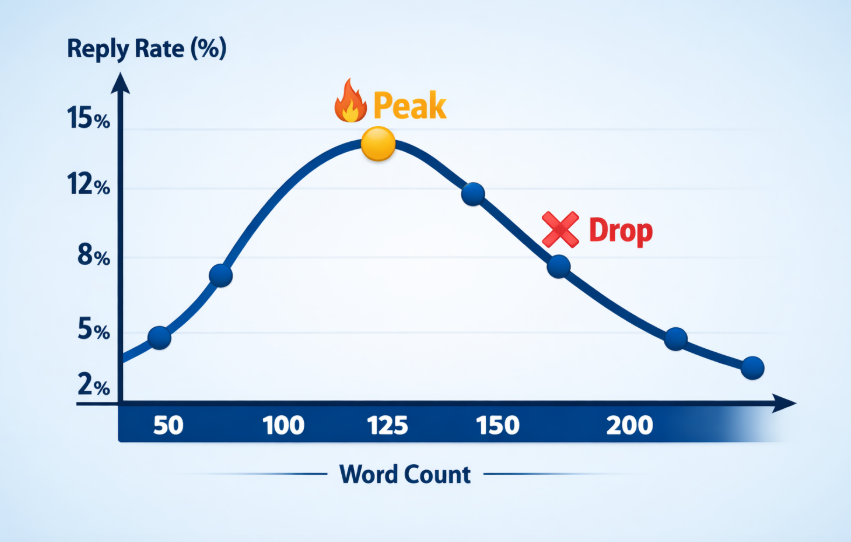
Data shows emails under 125 words get significantly higher reply rates compared to emails that go beyond 200 words, mainly because they respect the reader’s time.
The goal is not to explain everything but to spark interest and start a conversation.
👉 Mini takeaway:
If your email needs scrolling, it’s already too long.
Why Cold Email Length Matters More Than Ever
When you’re figuring out the ideal length of an email, it’s not just about word count anymore.
It’s about how people read, decide, and respond in today’s crowded inbox environment.
1. Short Attention Spans
Most people don’t “read” emails anymore, they scan them in seconds.
If your message doesn’t deliver value instantly, it gets ignored or archived without a second thought.
Long emails feel like effort, and effort kills curiosity before it even starts.
2. Mobile-First Reading Behavior
A majority of emails today are opened on mobile devices.
That means limited screen space, faster scrolling, and less patience for long paragraphs that don’t get to the point quickly.
If your email requires scrolling, you’re already losing attention halfway through.
3. Spam Filters & Deliverability
Email length also impacts how your message is perceived by spam filters.
Long, generic emails packed with unnecessary information can look like mass outreach, increasing the risk of landing in spam folders.
Short, relevant emails signal clarity and intent, which improves deliverability.
4. Reply Rate Impact
The biggest impact shows up in replies.
Emails between 50–125 words consistently hit the highest engagement window, while anything longer sees a noticeable drop in response rates.
The simpler your email feels, the easier it is for someone to reply.
Before you decide the ideal cold email length, you need to understand one thing — not every email should be the same length.
The context, intent, and relationship with the recipient all influence how much you should say.
A first-touch email is very different from a follow-up or a partnership pitch.
That’s why instead of one fixed number, it’s better to think in ranges based on use case.
Here’s a simple breakdown you can follow:
Ideal Cold Email Length by Use Case
If you notice closely, every type still stays within a tight range.
That’s because the ideal cold email length isn’t about saying more — it’s about saying just enough to move the conversation forward.
The Perfect Cold Email Length by Structure
Once you understand the ideal length of email, the real advantage comes from how you structure those words.
Because even within a short email, the way you present each section determines whether someone reads, connects, and replies.
1. Subject Line (4-5 Words)
Your subject line decides whether your email gets opened or ignored.
In just a few words, you need to create enough curiosity or relevance to make someone pause and click.
The best subject lines feel natural, specific, and slightly intriguing without trying too hard.
Instead of sounding promotional, focus on making it feel like a one-to-one conversation.
Simple phrasing often outperforms clever wording because clarity builds trust faster than creativity in cold outreach.
2. Opening Line (1–2 sentences)
Once your email is opened, the first line determines whether it gets read further.
This is where personalization matters the most, but it has to feel real, not forced.
Mention something specific about the person, their company, or their work that shows genuine intent behind your outreach.
A strong opening builds instant relevance and reduces the chances of your email being dismissed as spam.
It also sets the tone for a conversational flow rather than a sales pitch.
3. Value Proposition (2–3 sentences)
This is the core of your email where you communicate why you’re reaching out.
Instead of talking about your product or service, focus on the problem you solve and the outcome you create.
Keep your message clear and direct so the reader understands the value without having to think too much.
Avoid adding too many details or explanations because that increases friction and reduces engagement.
The goal here is simple — make the reader feel, “This might be relevant to me.”
4. Social Proof (Optional, 1 line)
If needed, add a quick credibility signal like a result, client name, or metric.
This builds trust instantly without increasing the length significantly.
5. CTA (1 sentence)
Close with one simple, low-effort question that’s easy to respond to.
👉 The ideal total stays within the 70–110 words sweet spot, keeping your email sharp, clear, and effective.
What Happens If Your Email Is Too Long (or Too Short)?
Finding the ideal cold email length is not just about staying within a range.
It’s about avoiding the two extremes that quietly kill your response rates.
Both overly long and overly short emails create friction, just in different ways.
1. Too Long (>150–200 words)
When your email gets too long, it starts losing attention quickly.
Instead of feeling like a conversation, it feels like a pitch.
Example of a long email:
- “Hi John, I came across your company and wanted to reach out because we offer a wide range of solutions that help businesses improve their outreach, increase conversions, optimize workflows, and scale operations efficiently…”
Continues explaining features, benefits, background, and multiple use cases
Ends with: “Let me know if you’re available sometime next week to discuss this in detail”
👉 Problem:
- Feels like marketing copy
- Hard to read fully
- CTA gets buried
2. Too Short (<40 words)
Very short emails can feel unclear or low-effort.
They don’t give enough reason to respond.
Example of a short email:
- “Hey, want to connect?”
- “Hi, we help companies grow. Interested?”
👉 Problem:
- Lacks context
- Feels generic or spammy
- No real value communicated
Key insight:
- Good email: “We help SaaS teams increase reply rates by 40%. Worth a quick chat?”
- Clear + short + meaningful
The goal is simple — balance clarity with brevity.
Real Data: What Length Gets the Best Replies?
If you’re wondering what is the ideal length of an email, real data gives a clear answer.
Emails between 50–125 words get the highest reply rates.
They are short enough to read quickly and clear enough to drive action.
Within this, ~100–120 words performs best, as it balances personalization, value, and a simple CTA.
But once you go longer, replies start dropping.
A common trend shows that every extra 25 words reduces engagement, mainly because longer emails feel harder to read.
👉 Quick takeaway:
- 50–125 words → Best results
- ~100 words → Sweet spot
- 150+ words → Lower replies
Visual: Word Count vs Reply Rate
Best Practices to Keep Your Cold Emails Short (Without Losing Impact)
Now that you know the ideal cold email length, the challenge is keeping your message short without losing meaning.
The key is not cutting randomly, but writing with intent.
1. Focus on One Idea Only
Every cold email should have one clear goal.
Trying to say too much in one message makes it confusing and reduces your chances of getting a reply.
2. Remove Company Background
Your recipient doesn’t need your full story.
Skip long introductions about your company and get straight to why you’re reaching out.
3. Avoid Multiple CTAs
Too many asks create friction and slow down decision-making.
Stick to one simple, clear call-to-action that’s easy to respond to.
4. Use Simple Language
Complex words and jargon make your email harder to read.
Write the way you would speak in a normal conversation.
5. Keep Sentences Under 20 Words
Short sentences improve readability and keep attention.
They also make your email easier to scan, especially on mobile devices.
👉 The goal is simple — keep your message clear, focused, and easy to act on without adding unnecessary length.
Quick Checklist: Ideal Cold Email Length
- ✅ 50–125 words total
- ✅ 4–7 sentences max
- ✅ One idea, one CTA
- ✅ Mobile-friendly (no scrolling)
- ✅ Personalized first line
Conclusion
The truth is, there’s no magic number when it comes to cold emails.
But there is a clear pattern — shorter, focused emails consistently perform better.
If you stay within the 50–125 word range, you give your message the best chance to be read, understood, and replied to.
Anything longer risks losing attention, and anything shorter may lack clarity.
The real goal isn’t just hitting the ideal cold email length, but making every word count.
When your email is easy to read and quick to respond to, you naturally increase your chances of getting a reply.
👉 Keep it simple, keep it relevant, and most importantly, keep it concise.
Read More: Cold Email Strategy
Frequently Asked Questions
What is the ideal length of a cold email?
The ideal cold email length is 50–125 words. This range is short enough to hold attention while still providing enough context to spark interest and get a reply.
How many sentences should a cold email have?
A strong cold email typically has 3–7 sentences. This keeps it concise, readable, and easy to scan—especially on mobile devices.
Does email length affect reply rates?
Yes, significantly. Shorter emails (under 125 words) tend to get higher reply rates because they are quicker to read and easier to respond to.
How can I keep my cold emails short but effective?
Focus on one goal, remove unnecessary details, use simple language, and stick to a single call-to-action. Every sentence should serve a clear purpose.
How does Oppora.ai help optimize cold email length?
Oppora.ai helps you write concise, high-performing cold emails by suggesting optimal length, improving clarity, and structuring your message to increase reply rates—without adding unnecessary words.