11 Sales Cadence Best Practices That Boost Reply Rates Fast
You send a few emails, follow up randomly, and hope something clicks — but most prospects never reply.
That’s what happens when your outreach lacks structure.
A sales cadence is simply a planned sequence of touchpoints across channels, designed to guide conversations and build momentum.
In this guide, you’ll learn:
- What makes a high-performing sales cadence
- Why structure directly impacts reply rates
- How to create a cadence that actually converts consistently
What Is a Sales Cadence?
A sales cadence is a planned sequence of touchpoints you use to reach a prospect over a period of time.
Instead of sending one email and hoping for a response, you follow a structured flow like:
- Day 1: Initial email
- Day 3: Follow-up email
- Day 5: LinkedIn connect
- Day 7: Second follow-up
Each step has a purpose, timing, and channel.
This makes your outreach feel intentional instead of random.
Why Sales Cadence Matters for Reply Rates
When your outreach is inconsistent, prospects forget you or never take you seriously.
That’s why random follow-ups often lead to silence.
A structured sales cadence solves this by:
- Keeping you consistently visible without being spammy
- Reinforcing your message across multiple touchpoints
- Giving prospects multiple chances to respond when timing feels right
Over time, this increases familiarity, trust, and response probability.
And that’s what ultimately drives higher reply rates.
Common Sales Cadence Mistakes That Kill Replies
Now that you understand what a sales cadence is, the next step is spotting what’s going wrong.
Because in most cases, low reply rates are not about bad leads — they come from avoidable cadence mistakes.
Sending Too Many Emails Too Fast
It’s tempting to follow up aggressively when you don’t hear back.
But sending emails too close together can quickly overwhelm your prospects and hurt your chances of getting a reply.
Instead of building interest, it creates irritation and makes your outreach feel pushy.
A better approach is to space your touchpoints thoughtfully:
- Give at least 2–3 days between early follow-ups
- Increase gaps slightly as the sequence progresses
- Avoid sending multiple emails within a short time window
Consistency matters, but timing matters even more.
Lack of Personalization
If every email you send looks and feels the same, prospects can spot it instantly.
And once your message feels generic, it gets ignored.
Many sales cadences fail because they focus on volume instead of relevance.
Even small personalization signals can change how your message is perceived:
- Mention the prospect’s role or company context
- Reference a recent update, post, or trigger event
- Align your message with a specific pain point
When your message feels tailored, it naturally earns more attention and replies.
Giving Up Too Early
Most replies don’t come from the first email.
They come after multiple touchpoints.
But many people stop too soon, assuming the prospect isn’t interested.
In reality, timing plays a huge role.
A strong sales cadence stays consistent without being intrusive:
- Plan at least 4–6 touchpoints in your sequence
- Mix channels like email and LinkedIn when possible
- Keep follow-ups short and value-driven
Sticking to your cadence gives you more chances to connect when the prospect is actually ready to respond.
Suggested Reading:
Cold Email Mistakes That Kill Replies11 Sales Cadence Best Practices
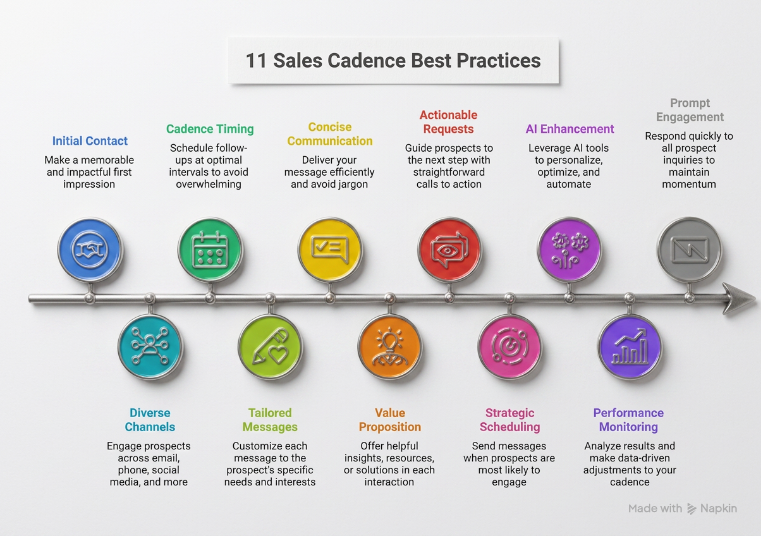
Now that you know what breaks a cadence, the next step is fixing it with the right structure.
These best practices will help you move from random outreach to a system that consistently drives replies.
1. Start With a Strong First Touch
Your first message sets the tone for everything that follows.
If it feels generic or irrelevant, the rest of your cadence won’t matter.
Focus on making your first touch count:
- Show clear relevance to the prospect
- Highlight a specific problem or opportunity
- Keep the message simple and direct
A strong start builds curiosity and makes future follow-ups feel natural.
2. Use Multi-Channel Outreach in Your Sales Cadence
Relying only on email limits your visibility.
Prospects engage across platforms, so your cadence should meet them where they are.
You can combine channels like:
- Email for structured communication
- LinkedIn for softer touchpoints
- Calls for high-intent prospects
This creates multiple chances to get noticed without increasing pressure.
3. Space Your Touchpoints Properly
Timing plays a huge role in how your outreach is perceived.
Too fast feels pushy, too slow gets you forgotten.
Follow a balanced structure:
- Keep 2–3 day gaps between early emails
- Increase spacing in later follow-ups
- Run the cadence across 2–3 weeks
This keeps you consistent without overwhelming the prospect.
Suggested Reading:
Best Time to Send Cold Emails4. Personalize Every Step of the Cadence
Personalization is not a one-time effort.
Every touchpoint should feel intentional and relevant.
You can improve personalization by:
- Referencing previous interactions
- Mentioning specific triggers or context
- Aligning with the prospect’s current priorities
Consistent personalization builds trust and familiarity over time.
5. Keep Messages Short and Clear
Long emails reduce engagement.
Most prospects skim messages and decide quickly whether to respond.
Keep your emails:
- Focused on one clear idea
- Free from unnecessary details or fluff
- Easy to read on mobile devices
Clarity makes it easier for prospects to respond.
6. Add Value in Every Touchpoint
If your follow-ups don’t add value, they get ignored.
Every message should give a reason to engage.
You can add value by:
- Sharing a relevant insight
- Pointing out a missed opportunity
- Offering something useful based on their situation
Value-driven outreach feels helpful instead of interruptive.
7. Use Clear and Simple CTAs
Your call-to-action should not create confusion.
If the next step is unclear, prospects won’t take action.
Make your CTA:
- Focused on one action only
- Easy to respond to
- Free from multiple choices
A simple CTA increases the chances of getting a reply.
8. Optimize Timing and Send Days
Even great emails fail if they are sent at the wrong time.
Timing affects visibility and engagement more than most people think.
You can improve timing by:
- Testing different send days and times
- Avoiding crowded inbox hours
- Tracking when your audience is most active
Small timing improvements can lead to noticeable gains in replies.
9. Use AI to Improve Your Sales Cadence
Managing a complete cadence manually becomes difficult as you scale.
This is where AI can simplify execution and improve consistency.
AI can help you:
- Build structured sequences automatically
- Personalize messages at scale
- Handle follow-ups without manual effort
And tools like Oppora make cold email campaigns relatively easy.
It gives you access to 1B+ verified contacts, builds your list, writes personalized emails, sends them, and follows up automatically.
You get 10,000 email lookup credits and can run unlimited campaigns, making it highly scalable.
This is not just email automation.
It’s a full outbound pipeline running end-to-end, so you don’t have to manage multiple tools.
10. Track and Improve Your Cadence Performance
If you don’t track performance, you can’t improve it.
Your cadence should evolve based on real data, not assumptions.
Focus on key metrics like:
- Reply rates
- Open rates
- Conversion to meetings
Regularly reviewing these helps you identify what’s working and what needs adjustment.
11. Don’t Ignore Replies — Respond Fast
Getting a reply is just the beginning.
How quickly you respond can directly impact conversions.
Delays can cause prospects to lose interest or move on.
You should:
- Reply as quickly as possible
- Keep responses clear and helpful
- Guide the conversation toward a next step
Faster responses create momentum and improve your chances of closing.
And this is where tools like Oppora help again.
They can automate replies, handle conversations, and even book meetings instantly, so you never miss an opportunity due to delays.
How can Oppora AI help you Build Sales Cadence
Now that you understand how a strong cadence works, the real challenge is execution at scale.
Because planning touchpoints is easy, but maintaining consistency across leads, follow-ups, and replies is where most workflows break.
Oppora solves this by acting as an AI outbound sales agent that runs your entire outbound process end-to-end.
You simply define what you sell and who you want to reach, and it handles lead generation, outreach, follow-ups, and replies automatically.
Features That Help You Build Cadence
Oppora is built to support every part of a high-performing cadence:
- Automated multi-step sequencesBuild structured outreach flows once, and let AI run them continuously without manual effort
- Personalization at scaleEvery message is uniquely generated, keeping your outreach relevant across all touchpoints
- Built-in lead generationAccess verified contacts with automatic enrichment, so your cadence starts with the right audience
- Follow-ups and AI repliesSends follow-ups, responds to prospects, and books meetings without delays
- Deliverability safeguardsIncludes inbox rotation, domain warm-up, and sender matching to protect your outreach
Instead of managing steps manually, Oppora turns your cadence into a system that runs consistently in the background.
Conclusion
A strong sales cadence is what turns random outreach into a predictable pipeline.
When you stay consistent, focus on personalization, and keep optimizing based on real data, your reply rates improve naturally over time.
The real advantage comes when you combine a solid strategy with the right tools, so you can scale outreach without increasing manual effort.
Frequently Asked Questions
1. How long should a sales cadence be?
A sales cadence typically runs for 2 to 3 weeks with multiple touchpoints to maintain consistency without overwhelming the prospect.
2. How many follow-ups are ideal in a sales cadence?
Most effective cadences include 3 to 5 follow-ups since replies often come after the initial outreach.
3. What is the best channel mix for a sales cadence?
A strong cadence combines email with channels like LinkedIn and sometimes calls to increase visibility and engagement.
4. How do I know if my sales cadence is working?
You can evaluate performance by tracking reply rates, engagement, and how many conversations convert into meetings.
5. Can I automate my sales cadence without losing personalization?
Yes, with the right tools you can automate outreach while still maintaining personalized messaging at scale.