What are Target Market Strategies? Types & How to Find Your Best-Fit Market
Growth becomes predictable the moment you stop trying to attract everyone.
The most successful companies aren’t those with the biggest audience — they’re the ones with the clearest focus. They know exactly who they serve, what problem they solve, and why their solution matters.
That clarity is built through strong target market strategies.
If your messaging feels broad, your leads are inconsistent, or conversions vary wildly, the root issue is often targeting — not effort.
Let’s break down what a target marketing strategy really means, the different types you can apply, and how to find your best-fit market step by step.
What Is a Target Market Strategy?
A target marketing strategy is a structured approach to identifying a specific group of customers most likely to purchase your product or service — and tailoring your messaging, positioning, and campaigns around them.
Instead of saying:
“We help businesses grow.”
You say:
“We help B2B SaaS founders increase qualified outbound meetings using AI-driven prospecting.”
That shift from broad to specific defines a strong targeted marketing strategy.
A well-defined strategy helps you:
- Improve conversion rates
- Reduce wasted ad spend
- Shorten sales cycles
- Strengthen brand positioning
- Increase customer lifetime value
In short, targeting improves efficiency and profitability.
Why Market Targeting Strategies Matter
Without clear market targeting strategies, businesses often:
- Attract low-quality leads
- Compete on price instead of value
- Struggle with inconsistent messaging
- Burn marketing budget
Precision creates alignment between marketing, sales, and product teams. And alignment drives scalable growth.
Types of Target Market Strategies
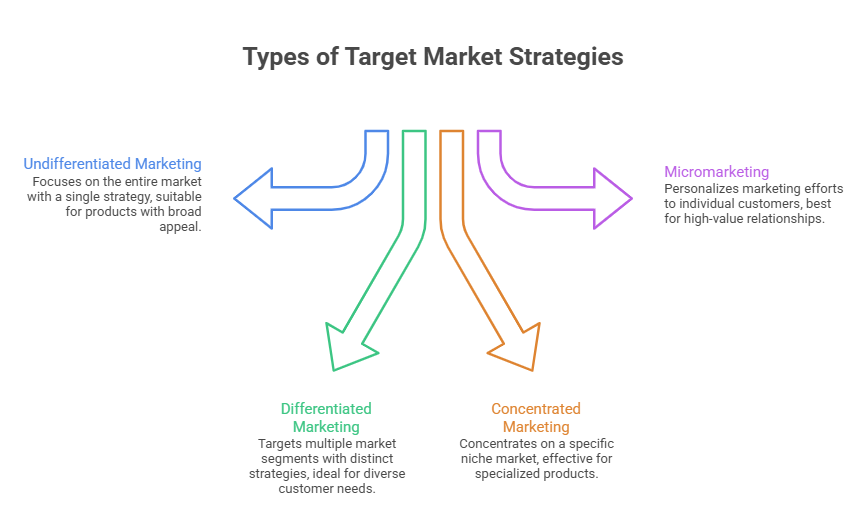
There are four primary types of target market strategies businesses use.
1. Undifferentiated (Mass) Marketing
This approach targets the entire market with one unified message.
It works best for large consumer brands and commodity products. For example, Coca-Cola runs broad campaigns designed to appeal to wide global audiences.
Pros:
- Maximum reach
- Simple messaging
Cons:
- Lower personalization
- High competition
2. Differentiated (Segmented) Marketing
This strategy targets multiple segments with tailored campaigns for each.
For example:
- Startups → Cost-effective automation tools
- Enterprises → Scalable AI infrastructure
A segmented targeted marketing strategy increases relevance but requires more resources.
3. Concentrated (Niche) Marketing
This strategy focuses on one specific segment and aims to dominate it.
Instead of targeting “all SaaS companies,” you might target:
Early-stage B2B SaaS founders generating $10k–$50k MRR struggling with outbound reply rates.
This approach is especially powerful for startups because it creates strong positioning and clearer messaging.
4. Micromarketing (Hyper-Personalized Targeting)
Micromarketing focuses on small segments or even individual accounts using data-driven insights.
It includes:
- Account-Based Marketing (ABM)
- Behavioral segmentation
- AI-driven prospecting
This approach transforms traditional market targeting strategies into predictive systems.
How to Find Your Best-Fit Market
Understanding the theory is useful. Applying it is what drives results.
Here’s a practical framework to define your best-fit audience.
Step 1: Analyze Your Best Existing Customers
Start with data.
Look at:
- Industry
- Company size
- Revenue range
- Job titles of buyers
- Deal size
- Retention rate
Your strongest segment often already exists within your current customer base.
Step 2: Identify Core Pain Points
Demographics tell you who they are. Pain points explain why they buy.
Ask:
- What urgent problem pushed them to look for a solution?
- What outcome mattered most to them?
- What made them choose you over alternatives?
Strong target market strategies are built around urgency and measurable outcomes — not vague profiles.
Step 3: Define Your Ideal Customer Profile (ICP)
Your ICP should clearly outline:
- Industry
- Company size
- Growth stage
- Revenue range
- Technology stack
- Buying triggers
The clearer your ICP, the stronger your target marketing strategy becomes.
Step 4: Evaluate Segment Profitability
Not every segment is worth equal effort.
Evaluate each potential segment based on:
- Market size
- Competition level
- Acquisition cost
- Sales cycle length
- Lifetime value
Focus on one primary segment before expanding.
Step 5: Test and Optimize Continuously
Targeting is not static.
Track:
- Engagement rates
- Conversion rates
- Deal velocity
- Retention
If one segment consistently outperforms others, double down. Refine messaging. Reallocate budget.
Great targeted marketing strategies evolve with data.
How Oppora.ai Helps Execute Target Market Strategies Effectively
Defining your best-fit market is strategic. Executing it consistently is operational.
Oppora.ai helps B2B sales and marketing teams apply their target marketing strategy in a structured, data-driven way.
Here’s how:
- AI-Based Prospect Discovery Identify companies and decision-makers using firmographic filters like industry, company size, role, and geography.
- Data Enrichment & Contact Verification Access validated contact information and enriched company data to ensure accurate outreach.
- ICP Refinement Through Engagement Signals Analyze response patterns and performance data to refine your ideal customer profile over time.
- Multi-Channel Outreach Automation Launch personalized email campaigns and coordinated LinkedIn outreach aligned with your defined segments.
- Lead Prioritization Focus sales efforts on high-fit accounts that match your targeting criteria.
Instead of relying on manual prospecting or assumption-based segmentation, Oppora.ai supports smarter execution of modern market targeting strategies.
Common Mistakes in Target Market Strategies
Avoid these common pitfalls:
- Targeting too broadly
- Confusing buyer personas with ICPs
- Relying only on assumptions
- Ignoring real performance data
- Copying competitors’ positioning
Clarity beats imitation.
Final Thoughts
A powerful target market strategy is not about limiting opportunity — it’s about increasing precision.
When you clearly define:
- Who you serve
- What problem you solve
- Which segment converts best
You stop chasing leads and start building predictable growth.
The companies that scale sustainably aren’t the ones shouting the loudest — they’re the ones targeting the smartest.
Frequently Asked Questions
Can a business have more than one target market strategy?
Yes. Many companies use multiple target marketing strategies simultaneously. For example, a SaaS company might use a concentrated strategy for startups while running a differentiated strategy for mid-market and enterprise segments. The key is ensuring each segment has clear positioning and tailored messaging.
Can startups compete with larger companies using niche targeting?
Absolutely.
Startups often outperform larger competitors by using concentrated target market strategies. By focusing on one narrow segment and solving one clear pain point exceptionally well, smaller companies can build stronger positioning and faster traction.
What is the purpose of a target marketing strategy?
The purpose of a target marketing strategy is to focus your marketing efforts on a specific group of customers most likely to buy your product. It improves conversion rates, reduces wasted spend, and creates clearer positioning in competitive markets.
How do target market strategies increase ROI?
Target market strategies increase ROI by reducing acquisition costs and improving lead quality. When you focus on high-fit segments, you shorten sales cycles, improve retention, and allocate marketing budget more efficiently.
What is the difference between niche marketing and mass marketing?
Niche marketing focuses on a small, specific segment with tailored messaging, while mass marketing targets a broad audience with one general message. Concentrated niche strategies often generate higher conversions for startups and B2B companies.
How does AI support targeted marketing strategy?
AI improves targeted marketing strategy by identifying high-fit prospects, analyzing engagement signals, and automating personalized outreach. Tools like Oppora.ai help B2B teams execute data-driven targeting more efficiently and consistently.