12 Cold Email Prospecting Templates for Sales Outreach
cold prospecting email templates, best cold prospecting emails, cold email for sales prospecting, cold prospecting email examples
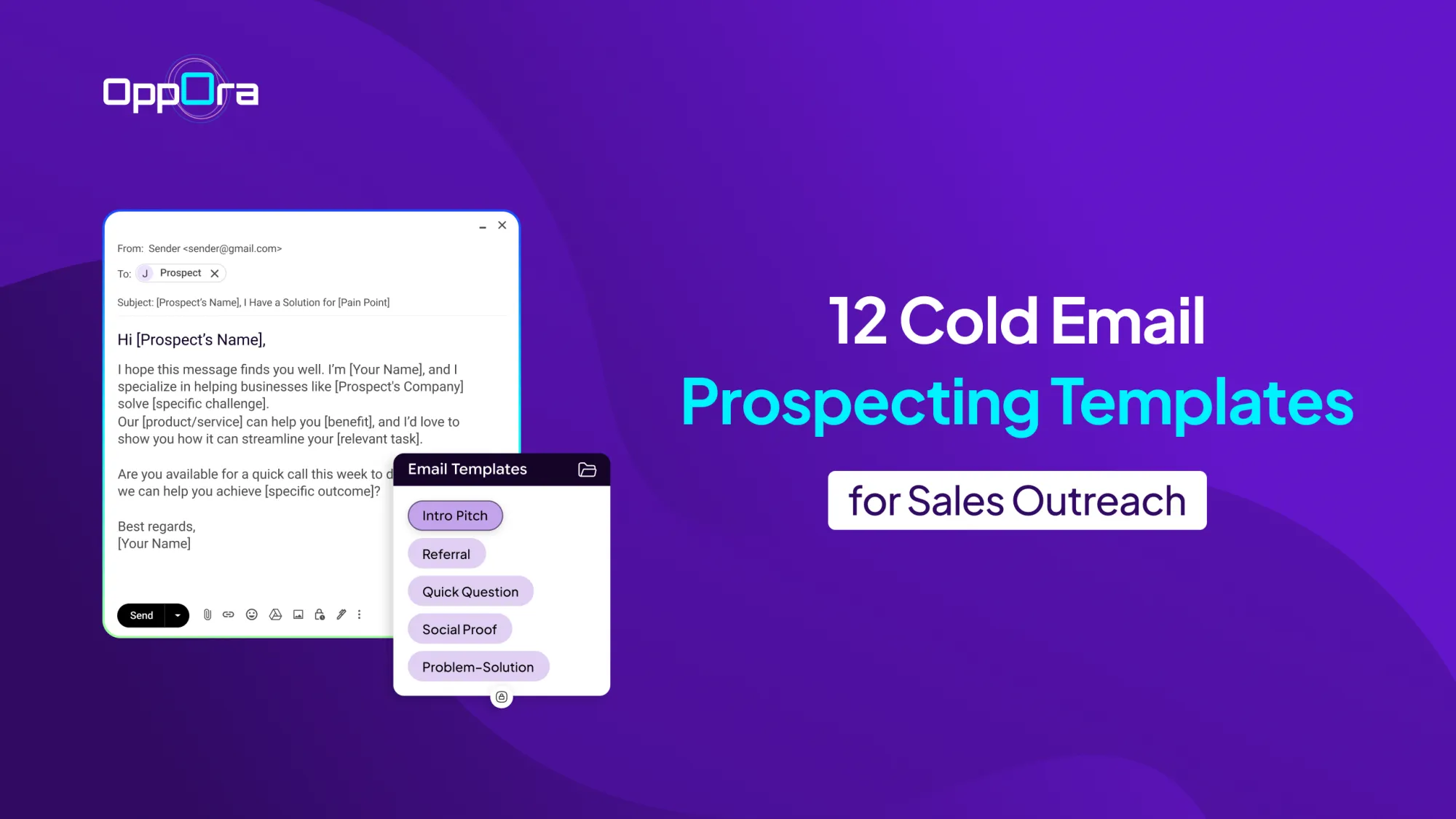
Cold email prospecting is essential for B2B sales. It helps businesses connect with potential customers who haven’t interacted with them before.
But crafting personalized cold emails can be time-consuming, especially when reaching out to many prospects. This is where email templates come in handy.
Templates streamline the process, saving time and boosting response rates. They provide a structure that can be quickly customized for different prospects.
In this blog, we’ll present 12 effective cold email prospecting templates. These templates will help you improve your outreach and connect with potential leads more efficiently.
What Is Cold Email Prospecting?
Cold email prospecting is reaching out to potential customers via email who haven’t previously interacted with your business.
In B2B sales, it plays a vital role in identifying and generating new leads. This process involves sending personalized emails to selected prospects, introducing your products or services, and addressing their pain points to engage them.
The ultimate goal is to spark a conversation that may lead to business opportunities. Cold email prospecting is an efficient and scalable method to expand outreach efforts and fill the sales pipeline with quality leads.
How Cold Email Prospecting Works
Cold email prospecting involves three main steps: identifying your target audience, crafting personalized emails, and following up effectively. These steps are essential for building a successful outreach strategy and increasing the chances of converting prospects into leads.
Identifying and Researching Your Target Audience
Researching and identifying the right target audience is crucial for cold email success. You need to focus on prospects who are likely to benefit from your offering.
- Research your target market based on factors like industry, job title, and location.
- Use tools like LinkedIn, CRM databases, and industry directories to find prospects.
- Narrow down the list to those who fit your ideal customer profile.
By targeting the right audience, you improve the chances of engagement and build a more effective prospecting list.
Crafting and Sending Cold Emails
Once you've identified your prospects, it’s time to craft a compelling cold email. A well-structured email can spark a conversation and create interest.
- Write a catchy and clear subject line to grab attention.
- Personalize your email, showing that you've done research on the prospect.
- Focus on how your product or service addresses their pain points.
- End with a strong, clear call-to-action (CTA) to encourage a response.
An effective cold email is one that speaks directly to the prospect’s needs and prompts them to take action.
Follow-Up Strategies
Follow-ups are essential in cold email prospecting as many prospects may not respond to the first email. Timing and tone are key to a successful follow-up on cold email.
- Wait 3-5 days after the initial email before following up.
- Keep the follow-up message brief and polite.
- Remind them of your initial email and the value you’re offering.
- Include a clear CTA, such as scheduling a call or replying to the email.
Following up shows persistence and reinforces your value without being too aggressive or overwhelming.
Key Elements of a Successful Cold Prospecting Email
A successful cold prospecting email focuses on three key elements: a compelling subject line, an engaging body, and a strong call-to-action (CTA). These components help drive responses and make your email stand out.
Crafting a Compelling Subject Line
The subject line is the first thing a prospect will see, making it essential to grab their attention. It should spark curiosity, provide value, and entice the recipient to open your email.
- Keep it short, ideally under 50 characters.
- Avoid clickbait; be clear about the value you're offering.
- Personalize it with the prospect's name or company for a more targeted approach.
- Experiment with urgency, questions, or a specific benefit to stand out.
Best cold email subject line increases your open rates and sets the stage for a positive email experience.
Writing a Clear and Engaging Body
Once the subject line has been opened, the body of the email should be equally compelling. The goal is to engage the reader quickly and keep them interested throughout.
- Start with a personalized greeting or reference to something relevant.
- Keep the email concise and to the point; avoid unnecessary fluff.
- Focus on how your product or service solves their pain points.
- Use bullet points or short paragraphs for easy readability.
A clear and engaging body will make it easier for the prospect to understand your value and stay engaged with the email.
Call to Action (CTA)
The CTA is the most important part of any cold email. It guides the recipient on what to do next and encourages them to take action.
- Make your CTA clear, concise, and action-oriented.
- Use verbs like “schedule,” “reply,” or “download” to prompt action.
- Offer value, such as a free consultation or demo, to incentivize action.
- Avoid making the CTA too pushy; keep it friendly and professional.
A strong CTA increases the chances of getting a response and driving further engagement with the prospect.
12 Cold Email Prospecting Templates for Sales Outreach
Below are 12 cold email prospecting templates that can be used in various sales outreach scenarios. Each template is tailored to different approaches, ensuring you have a versatile toolkit for reaching out to potential prospects.
1. Introductory Pitch Email
Template:
Subject: [Prospect’s Name], I Have a Solution for [Pain Point]
Hi [Prospect’s Name],
I hope this message finds you well. I’m [Your Name], and I specialize in helping businesses like [Prospect's Company] solve [specific challenge]. Our [product/service] can help you [benefit], and I’d love to show you how it can streamline your [relevant task].
Are you available for a quick call this week to discuss how we can help you achieve [specific outcome]?
Best regards, [Your Name]
Use Case: This email works well as an introductory outreach to introduce your offering and how it addresses the prospect’s pain points.
2. Referral Email
Template:
Subject: [Referral’s Name] Suggested I Reach Out
Hi [Prospect’s Name],
I was chatting with [Referral’s Name], and they suggested I get in touch with you. We’ve helped [Referral’s Name’s company] achieve [result], and I thought our [product/service] could provide the same benefits to your team at [Prospect’s Company].
Would you be open to a quick call to explore how we can support your goals?
Best, [Your Name]
Use Case: This template leverages a mutual connection to build trust and credibility right from the start.
3. Quick Question Email
Template:
Subject: Quick Question for You, [Prospect’s Name]
Hi [Prospect’s Name],
I was wondering if [specific challenge] is something you’re currently working to improve at [Prospect’s Company]? We’ve helped similar businesses tackle this by [solution].
I’d love to hear if this is something you’re focusing on and how we might assist.
Best, [Your Name]
Use Case: This email is designed to spark curiosity and encourage a response with an open-ended question.
4. The "Social Proof" Approach
Template:
Subject: See How [Company Name] Benefited from [Your Product]
Hi [Prospect’s Name],
I wanted to share how we helped [Company Name] improve [specific result] using our [product/service]. Here’s a brief case study on how they achieved [result].
I’d love to show you how we can help [Prospect’s Company] achieve the same success. Could we set up a quick call?
Best, [Your Name]
Use Case: Using testimonials or case studies to build credibility and show tangible results from your offering.
5. Problem-Solution Email
Template:
Subject: Struggling with [Problem]? Here’s a Solution
Hi [Prospect’s Name],
Many businesses in [industry] face challenges with [specific problem]. At [Your Company], we’ve developed a solution that helps companies like yours [specific benefit].
Would you be open to learning more about how we can help [Prospect’s Company] with this issue?
Best regards, [Your Name]
Use Case: This template is designed to directly address a pain point and offer a solution that aligns with the prospect’s needs.
6. Value Proposition Focused
Template:
Subject: Unlock [Benefit] with [Your Product]
Hi [Prospect’s Name],
I wanted to reach out because our [product/service] has helped companies like yours [specific benefit]. With [unique feature], you’ll be able to [specific result] quickly and efficiently.
I’d be happy to share how we can help you achieve similar results. Would you be open to a quick chat?
Best, [Your Name]
Use Case: This email emphasizes the unique value your product offers and how it can specifically benefit the prospect.
7. Follow-Up Email Template
Template:
Subject: Just Following Up
Hi [Prospect’s Name],
I wanted to follow up on my previous email regarding [your product/service]. I know things can get busy, but I believe our [product/service] can help you [specific benefit].
Let me know if you’re available for a brief conversation to discuss further.
Best, [Your Name]
Use Case: A polite reminder to keep the conversation going after the initial outreach without being too pushy.
8. Competitor Comparison Email
Template:
Subject: How We Compare to [Competitor’s Name]
Hi [Prospect’s Name],
I noticed that you’re using [Competitor’s Product], and I wanted to share a quick comparison of how our [product/service] might better meet your needs. Unlike [Competitor’s Name], we offer [unique benefit].
Would you be open to a discussion on how we can provide better value for [Prospect’s Company]?
Best, [Your Name]
Use Case: This email compares your solution to a competitor's, highlighting your unique benefits and why your offering is a better choice.
9. The Humor Approach Email
Template:
Subject: No, We’re Not Another [Generic Service]
Hi [Prospect’s Name],
I promise, we’re not another [generic service]. We actually help [specific task] in a way that’s [funny/creative], and I’d love to show you how it works.
What’s the best time to chat about how we can help [Prospect’s Company]?
Best regards, [Your Name]
Use Case: This email uses humor to break the ice and make a memorable first impression while addressing the prospect’s needs.
10. Limited-Time Offer Email
Template:
Subject: [Special Offer] for [Prospect’s Company]
Hi [Prospect’s Name],
For a limited time, we’re offering [special discount/offer] to businesses like [Prospect’s Company] to help you get started with [product/service].
This is a great opportunity to [achieve specific result]. Let me know if you’d like to discuss how we can get you started.
Best, [Your Name]
Use Case: This template creates a sense of urgency with a limited-time offer, encouraging the prospect to act quickly.
11. Three-Sentence Cold Email
Template:
Subject: Quick Question, [Prospect’s Name]
Hi [Prospect’s Name],
I help companies like [Prospect’s Company] with [specific task] using [product/service]. Are you available for a quick call to discuss how we can help?
Best regards, [Your Name]
Use Case: A concise, direct approach for busy prospects who prefer short and to-the-point communication.
12. Personal Connection Email
Template:
Subject: A Quick Question About [Personalized Detail]
Hi [Prospect’s Name],
I noticed you’re involved with [specific project/interest] at [Prospect’s Company], and I thought I’d reach out. We specialize in helping companies like yours [specific benefit], and I’d love to discuss how we can support your work.
Could we schedule a brief call to explore how we can help?
Best, [Your Name]
Use Case: This email focuses on creating a personal connection with the prospect based on mutual interests or relevant details.
Quick Tips for Making Your Own Prospecting Email Templates
Creating your own cold email templates can be a game-changer in your outreach efforts. Here are some tips to help you design effective and engaging templates that resonate with your prospects and drive better results.
Focus on the Prospect’s Pain Points
Understanding your audience’s pain points is critical for crafting a message that resonates.
- Identify the challenges your prospects are facing and position your product or service as the solution.
- Show empathy and relate to their struggles to build trust and credibility.
- Highlight how your offering can alleviate their specific problems.
Focusing on pain points ensures your emails are relevant and immediately valuable to the prospect.
Keep It Short and Sweet
Concise messaging is key when engaging busy prospects.
- Keep your emails brief, focusing on the most important information.
- Avoid long paragraphs or unnecessary details that may overwhelm the reader.
- Use bullet points and short sentences to improve readability.
A short, clear message increases the chances of your email being read and responded to.
Personalize Your Approach
Adding a personal touch can make your email stand out and increase engagement.
- Address the prospect by name and reference something specific about their business or industry.
- Avoid using generic templates that feel robotic or impersonal.
- Tailor each email to the prospect’s needs and interests for a more authentic connection.
Personalization makes your email more memorable and increases the likelihood of a positive response.
How Oppora.ai Can Help Automate Cold Email Prospecting
Oppora.ai offers a comprehensive suite of AI-powered tools to automate and optimize your cold email prospecting. With features designed to personalize emails, streamline outreach, and manage responses, Oppora.ai helps you increase engagement and efficiency, all while saving you valuable time. Here's how it can take your cold email campaigns to the next level:
AI-Powered Personalization
Oppora.ai’s AI-driven personalization ensures that each cold email is customized for higher relevance and engagement.
- Data-Driven Personalization: AI analyzes data points to tailor each email based on the prospect’s industry, pain points, and specific needs.
- [Prospect Name]: AI dynamically personalizes each email by inserting variables such as the prospect’s name, company, and industry.
- [Pain Point/Benefit]: AI tailors content based on the prospect's specific pain points, addressing their needs directly.
- Scalable Personalization: Send unlimited emails with personalised content, ensuring each message feels unique without sacrificing efficiency.
This level of personalization results in 50% higher open rates and 35% more responses, making your outreach campaigns more successful and effective.
Multi-Inbox Support for Safer Outreach
Oppora.ai ensures your cold email campaigns run smoothly and securely, thanks to its multi-inbox support and built-in safety features.
- Inbox Rotation: Oppora.ai allows you to rotate between up to 50 inboxes, reducing the risk of your emails being flagged as spam by email providers.
- Warm-Up Features: Automated inbox warm-up ensures that your sender reputation remains healthy and your emails avoid deliverability issues.
- Improved Deliverability: This strategy decreases bounce rates by up to 40%, helping you maintain high-quality, consistent outreach.
By scaling your outreach safely, you’re able to maintain a reliable email delivery rate, reaching more prospects and increasing your chances of success.
Reply Handling and Meeting Scheduling
Handling responses and scheduling meetings can be time-consuming, but with Oppora.ai’s automation, this process is made effortless.
- Automated Reply Handling: AI processes responses, categorizing them into positive, negative, and neutral replies, and provides the appropriate follow-up actions.
- Follow-Up Automation: Oppora.ai sends automatic follow-ups, personalized based on the response type, helping maintain the conversation and nurturing leads.
- Seamless Meeting Scheduling: AI directly integrates with your calendar, booking meetings based on the prospect’s availability without any manual intervention.
These automated features can save you up to 20 hours per week, allowing you to focus on high-priority tasks while ensuring that no lead falls through the cracks.
By leveraging AI for reply handling and
Conclusion
Cold email prospecting is essential for B2B sales, and using well-crafted templates makes the process more efficient. By personalizing emails and addressing pain points, you can drive better results and build stronger connections.
Using templates saves time and increases response rates. Customizing them for different scenarios ensures your outreach stays relevant and impactful.
Ready to enhance your cold email outreach? Let Oppora.ai automate and personalize your emails to improve your prospecting efforts and boost your success.
Frequently Asked Questions (FAQs)
What Makes a Cold Email Effective?
A cold email is effective when it’s personalized, concise, and addresses the recipient's pain points. A compelling subject line, clear value proposition, and a strong call-to-action (CTA) help engage the prospect and prompt a response.
How Often Should I Follow Up on Cold Emails?
It’s best to follow up 3-5 days after your initial email. Space out follow-ups to avoid being pushy typically, 2-3 follow-ups are enough to stay on the prospect’s radar without overwhelming them.
Can Cold Email Prospecting Be Automated?
Yes, cold email prospecting can be automated with tools like Oppora.ai. These platforms help personalize emails, schedule follow-ups, and manage responses, saving time while improving outreach efficiency.
How Do I Avoid My Cold Emails Going to Spam?
To avoid spam filters, use a clean, verified email list, personalize your emails, and rotate inboxes to maintain a healthy sender reputation. Tools like Oppora.ai can help with inbox rotation and warm-up.
What Tools Can I Use to Improve My Cold Email Prospecting?
Tools like Oppora.ai, Snov.io, and Hunter.io can enhance cold email prospecting. They help with email list management, personalization, and automation, improving outreach efficiency and effectiveness.