Cold Email vs LinkedIn: Which Performs Better for B2B Outreach?
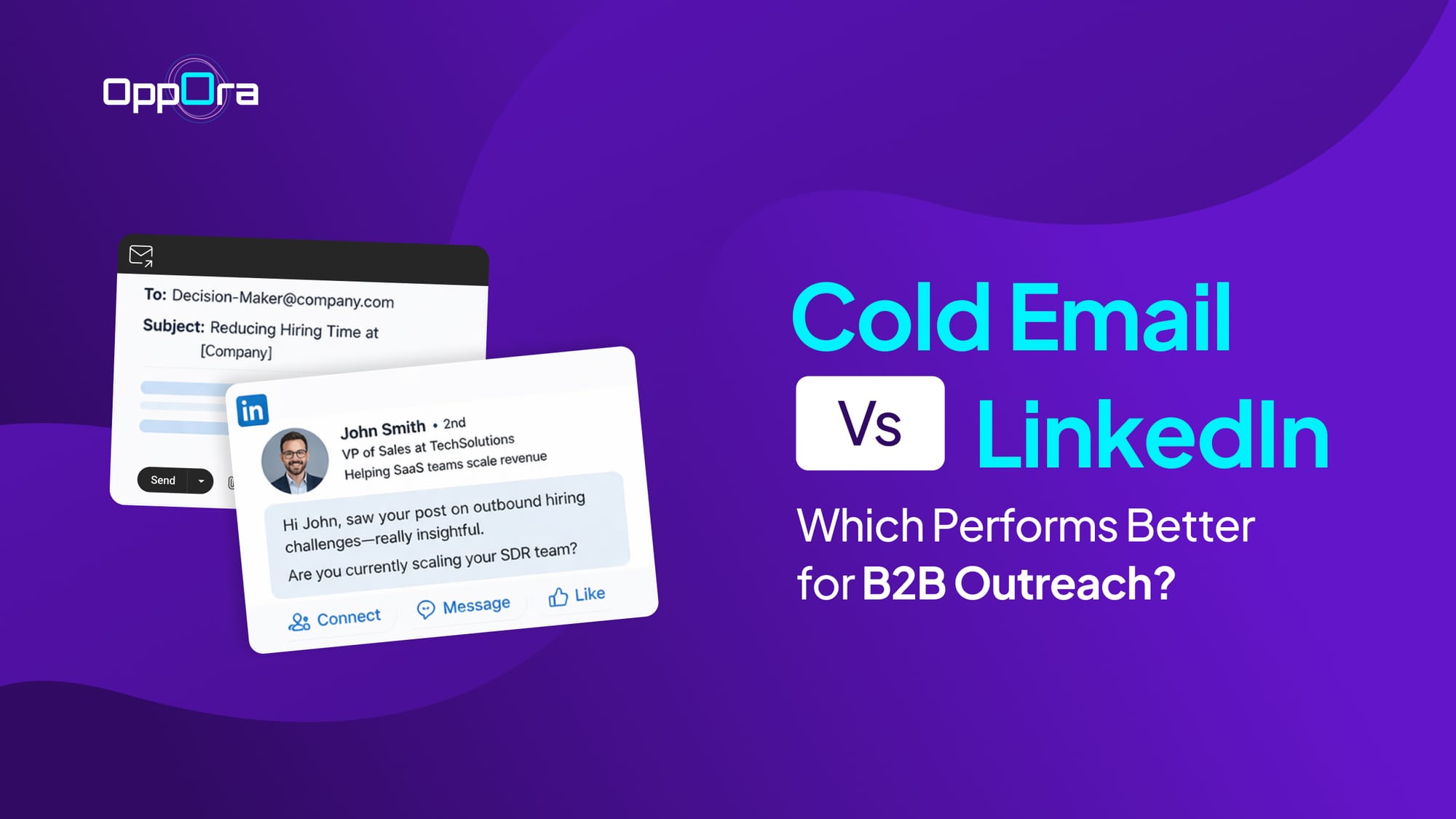
You’ve built a great product. You’ve defined your ICP. Now comes the hardest part—starting conversations with the right prospects.
That’s where most B2B teams get stuck:
- Should you scale with cold email?
- Or build relationships through LinkedIn?
The debate around cold email vs LinkedIn isn’t new—but the answer has evolved. What worked 3 years ago doesn’t necessarily work today.
In this guide, we’ll break down:
- Real performance data
- When each channel works best
- Practical use cases
- And how to combine both for maximum ROI
Let’s get into it.
What is Cold Email in B2B Outreach?
Cold email is the process of reaching out to prospects who haven’t interacted with your business before—via personalized, targeted email campaigns.
Unlike spam, effective cold email relies on:
- Strong targeting
- Personalization
- Follow-ups
- Deliverability setup
Why teams still rely on cold email:
- Unlimited scalability
- Direct access to decision-makers
- Low cost per outreach
But there’s a catch…
👉 Most cold emails fail because they’re generic.
Industry data shows ~95% of cold emails go unanswered, with average reply rates around 4–5%.
What is LinkedIn Outreach?
LinkedIn outreach involves connecting and engaging with prospects directly on LinkedIn through:
- Connection requests
- Direct messages
- Content engagement
Unlike email, LinkedIn provides context before the message:
- Profile credibility
- Mutual connections
- Content activity
This makes outreach feel less “cold.”
And it shows in the data.
👉 LinkedIn messages typically see 10–15% response rates, often 2x higher than cold email.
Cold Email vs LinkedIn: Key Differences (With Examples)
Choosing between cold email and LinkedIn isn’t just about picking a channel—it’s about understanding how buyers behave in each environment.
Let’s break this down in a way that actually helps you decide.
1. Outreach Environment: Inbox vs Social Context
Cold email lands in a private, distraction-heavy inbox. Your message competes with:
- Internal emails
- Promotions
- Spam filters
The recipient has zero context about you unless your subject line and opening line create it instantly.
LinkedIn, on the other hand, is a context-rich environment:
- Your profile acts as a landing page
- Mutual connections build instant credibility
- Activity (posts, comments) reinforces trust
👉 Key Insight: Cold email requires you to create trust from scratch, while LinkedIn allows you to borrow trust from context.
2. First Impression Mechanics
In cold email, your subject line is the gatekeeper. If it doesn’t grab attention immediately:
- The email isn’t opened
- Your message is never seen
You’re competing with dozens of emails, so the decision happens in 2–3 seconds.
Example (Cold Email):
Subject: “Quick question” → ignored Subject: “Reducing hiring time at [Company]” → opened
👉 One line determines everything.
In LinkedIn, the first impression is layered, not single-point.
Before even reading your message, the prospect sees:
- Your name
- Your headline (what you do)
- Your profile photo
- Mutual connections or activity
They may even check your profile before replying.
Example (LinkedIn): You send:
“Hey John, quick question…”
Even this works because your profile says:
“Helping SaaS teams hire faster”
👉 The profile builds trust before the message, reducing friction.
3. Personalization Depth
Cold email personalization is typically structured and inserted into a template:
- Name, company, role
- Trigger events (funding, hiring, expansion)
Example (Cold Email):
“Congrats on your recent funding—thought this might be relevant…”
It works, but the prospect knows it’s part of a system.
LinkedIn allows behavior-driven, real-time personalization:
- Referencing posts they wrote
- Engaging before messaging
- Joining ongoing conversations
Example (LinkedIn): Step 1: Comment on their post
“Great point on outbound hiring challenges”
Step 2: Message
“Your post on outbound really stood out—are you scaling your SDR team right now?”
👉 This feels natural and contextual, not templated.
4. Attention & Timing
Cold email is consumed in task mode:
- During work hours
- Between meetings
- While clearing inbox
The goal of the reader is efficiency, not exploration.
Example: A VP scans your email in 5 seconds → If it’s not instantly relevant → ignored
LinkedIn is used in discovery mode:
- Scrolling during breaks
- Engaging with ideas
- Open to conversations
Example: The same VP scrolling LinkedIn is more likely to:
- Read your message
- Check your profile
- Respond casually
👉 Same message, different mindset = different outcome
Psychology:
- Email = “What do I need to do?”
- LinkedIn = “What’s interesting here?”
5. Follow-Up Dynamics
Cold email follow-ups are linear and visible:
- Day 1: Initial email
- Day 3: Follow-up
- Day 7: Reminder
If not done well, they feel repetitive.
Example (Cold Email):
“Just following up on my last email…”
👉 Easy to ignore or mark as spam.
LinkedIn follow-ups are multi-dimensional and subtle:
- Profile views
- Post likes
- Comments
- Then message
Example (LinkedIn):
- Day 1: Connect
- Day 3: Like their post
- Day 5: Comment
- Day 7: Message
👉 You’ve built familiarity without direct pressure
That’s the key difference: 👉 On LinkedIn, follow-ups don’t always look like follow-ups.
6. Deliverability vs Visibility
Cold email success heavily depends on technical infrastructure:
- Domain reputation
- SPF, DKIM, DMARC setup
- Email warm-up
- Spam filters
Even a strong message can fail if it never reaches the inbox.
Example: Send 1,000 emails →
- 300 in spam
- 200 not delivered
- Only ~500 actually seen
👉 Performance drops before content is even judged.
LinkedIn removes this technical layer:
- Messages are delivered directly
- No spam filters blocking you
But visibility depends on human behavior:
- Do they accept your request?
- Are they active?
👉 Clear difference:
- Cold email = technical risk
- LinkedIn = behavioral risk
7. Conversion Journey
Cold email is designed for speed and direct action:
- Clear CTA
- Fast decision-making
- Transaction-focused
Example (Cold Email):
“Open to a 15-min call this week?”
👉 Works well when intent is clear and timing is right.
LinkedIn follows a relationship-first conversion path:
- Conversation → value → trust → action
Example (LinkedIn):
- “Saw your post on hiring challenges”
- Share insight or resource
- Then: “Happy to show how we’re solving this—open to a quick chat?”
👉 By the time you pitch, resistance is lower.
8. Scalability vs Authenticity Trade-Off
Cold email is built for scale:
- Automation tools
- Bulk sending
- Sequences
Example:
- 5 inboxes
- 1,000 emails/day 👉 Massive reach
But as volume increases: 👉 Personalization quality often drops
LinkedIn is built for authenticity:
- Manual engagement
- Real conversations
- Context-driven outreach
Example:
- 20–30 interactions/day 👉 Lower volume, but deeper conversations
For few more, let’s check comparison table
Cold Email vs LinkedIn — What Actually Works?
So, which performs better for B2B outreach—cold email or LinkedIn?
The honest answer: it depends on what you’re optimizing for.
- If you need scale and speed, cold email is unmatched.
- If you want trust and meaningful conversations, LinkedIn performs better.
But as we’ve seen throughout this guide, the real difference isn’t just in performance metrics—it’s in how prospects experience your outreach.
Cold email is direct, efficient, and scalable—but often starts with zero trust. LinkedIn is contextual, relationship-driven, and engaging—but harder to scale.
👉 That’s why the highest-performing B2B teams don’t choose one over the other. They combine both to balance reach with relevance.
A modern outreach strategy looks like this:
- Use LinkedIn to build familiarity and credibility
- Use cold email to scale and drive action
- Use both together to stay visible across multiple touchpoints
Because in today’s market, one message is rarely enough.
How Oppora Enhances Cold Email and LinkedIn Outreach
Choosing between cold email and LinkedIn doesn’t have to be an either/or decision. Oppora helps B2B teams combine the strengths of both channels, making outreach smarter, more personalized, and highly effective.
Why Oppora.ai Works for Multi-Channel B2B Outreach:
- Find the Right Prospects Quickly
- Personalize Outreach at Scale
- Generates tailored messaging for cold emails and LinkedIn interactions, keeping communication contextual and natural.
- Tracks prospect activity, enabling timely engagement that feels relevant, not templated.
- Coordinate Multi-Touch Campaigns
- Combines personalised LinkedIn connection request automation with cold email sequences.
- Ensures your outreach follows a logical journey: awareness → credibility → action, without overwhelming the prospect.
- Measure Performance and Optimize
- Monitors reply rates, engagement, and conversions across both channels in a single dashboard.
- Offers insights to refine timing, messaging, and follow-up strategies for maximum ROI.
With Oppora, B2B outreach is no longer a trade-off between scale and authenticity. You get the efficiency of cold email combined with the relationship-driven power of LinkedIn, creating a multi-channel system that drives higher engagement, better conversions, and stronger long-term relationships.
Final Takeaway
It’s no longer cold email vs LinkedIn.
It’s how well you orchestrate both channels together.
And that’s where most teams struggle—not with tools, but with execution and consistency.
With platforms like Oppora.ai, you can:
- Identify the right prospects faster
- Personalize outreach across channels
- Run coordinated campaigns instead of disconnected efforts
👉 Instead of choosing a channel, you build a system that works across both.
Frequently Asked Questions
When should you choose LinkedIn over cold email?
Choose LinkedIn when:
- You’re targeting senior decision-makers
- Deals require trust and multiple touchpoints
- You’re running account-based marketing (ABM)
- Your audience is active on LinkedIn
👉 If the sale needs context and credibility, LinkedIn performs better.
When should you choose cold email over LinkedIn?
Choose cold email when:
- You need fast pipeline generation
- You’re testing new messaging or markets
- Your audience is less active on LinkedIn
- You want to reach a large volume quickly
👉 If speed and scale matter more than depth, cold email wins.
Why does LinkedIn outreach sometimes not work?
LinkedIn fails when:
- Messages feel like copy-paste pitches
- There’s no prior engagement or context
- Profiles lack credibility (no content, weak headline)
- Follow-ups are too aggressive
👉 LinkedIn works best when it feels like networking, not selling.
Can cold email and LinkedIn be used together effectively?
Yes—and this is where the best results come from.
Example workflow:
- Engage on LinkedIn (view profile, like post)
- Send a personalized email referencing that interaction
- Follow up on LinkedIn
👉 This creates multiple touchpoints and increases reply rates significantly
Which channel gives better ROI in the long run?
- Cold email gives short-term ROI through scale
- LinkedIn gives long-term ROI through relationships and brand
👉 Combined, they deliver the highest ROI.