How to Increase B2B Sales: 12 Proven Strategies for Faster Growth
increase b2b sales strategies to increase b2b sales ways to increase b2b sales

Struggling to increase B2B sales even after sending hundreds of emails and running multiple campaigns?
You’re not alone — most teams don’t fail because of effort, but because their approach lacks structure, timing, and clarity.
The good news is, fixing this doesn’t require complex tactics.
It just needs a simple, repeatable system.
In this guide, you’ll learn:
- How to increase B2B sales with proven strategies
- Common mistakes that slow down growth
- Practical ways to improve targeting, outreach, and conversions
Why Most B2B Sales Strategies Fail to Increase B2B Sales
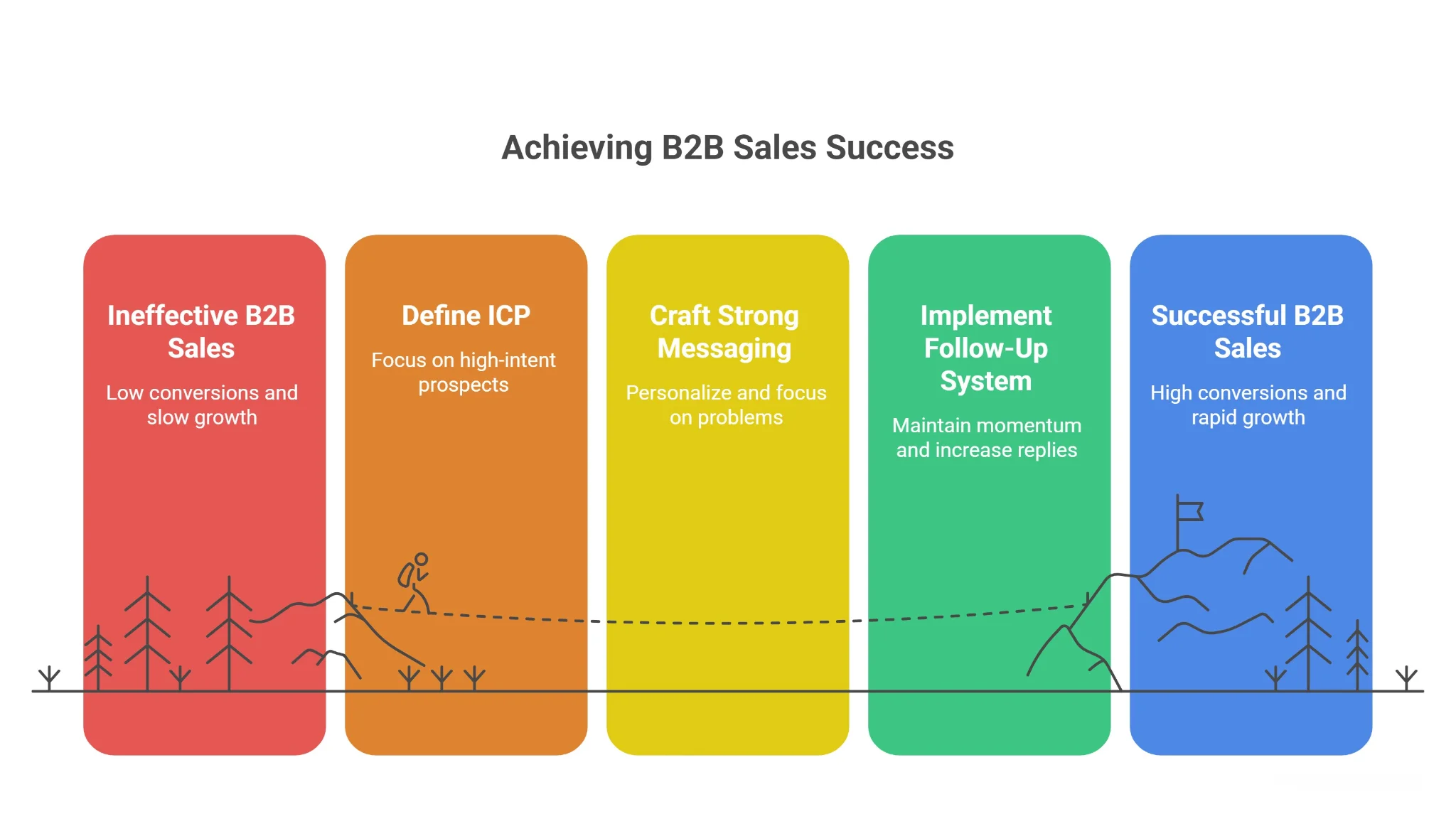
If you’re trying to increase B2B sales but not seeing results, the issue is rarely effort.
It usually comes down to a few fundamental gaps in how your sales process is built and executed.
Most teams repeat the same mistakes, which quietly reduce conversions and slow down pipeline growth.
Poor ICP Definition and Broad Targeting
When your targeting is too broad, your message loses relevance before it even reaches the prospect.
Instead of focusing on a clearly defined audience, many teams try to reach everyone and end up connecting with no one.
This leads to:
- Low response rates because the message feels generic
- Wasted time on unqualified prospects
- Difficulty scaling outreach effectively
A narrow and well-defined ICP helps you focus only on high-intent prospects who are more likely to convert.
Generic Messaging That Fails to Create Interest
Even with the right audience, weak messaging can stop your outreach from working.
If your message sounds like everyone else’s, it gets ignored instantly.
Buyers pay attention only when they feel the message speaks directly to their situation.
Strong messaging is:
- Clear and easy to understand
- Focused on one specific problem
- Personalized enough to feel relevant
When your communication improves, your chances of starting real conversations increase significantly.
Lack of a Structured Follow-Up System
Most sales don’t happen on the first message.
But without a proper follow-up system, opportunities slip through the cracks.
A consistent follow-up approach ensures you stay visible and relevant.
It helps you:
- Maintain momentum with interested prospects
- Increase reply rates over time
- Turn initial interest into actual sales conversations
Core Elements That Help Increase B2B Sales Consistently
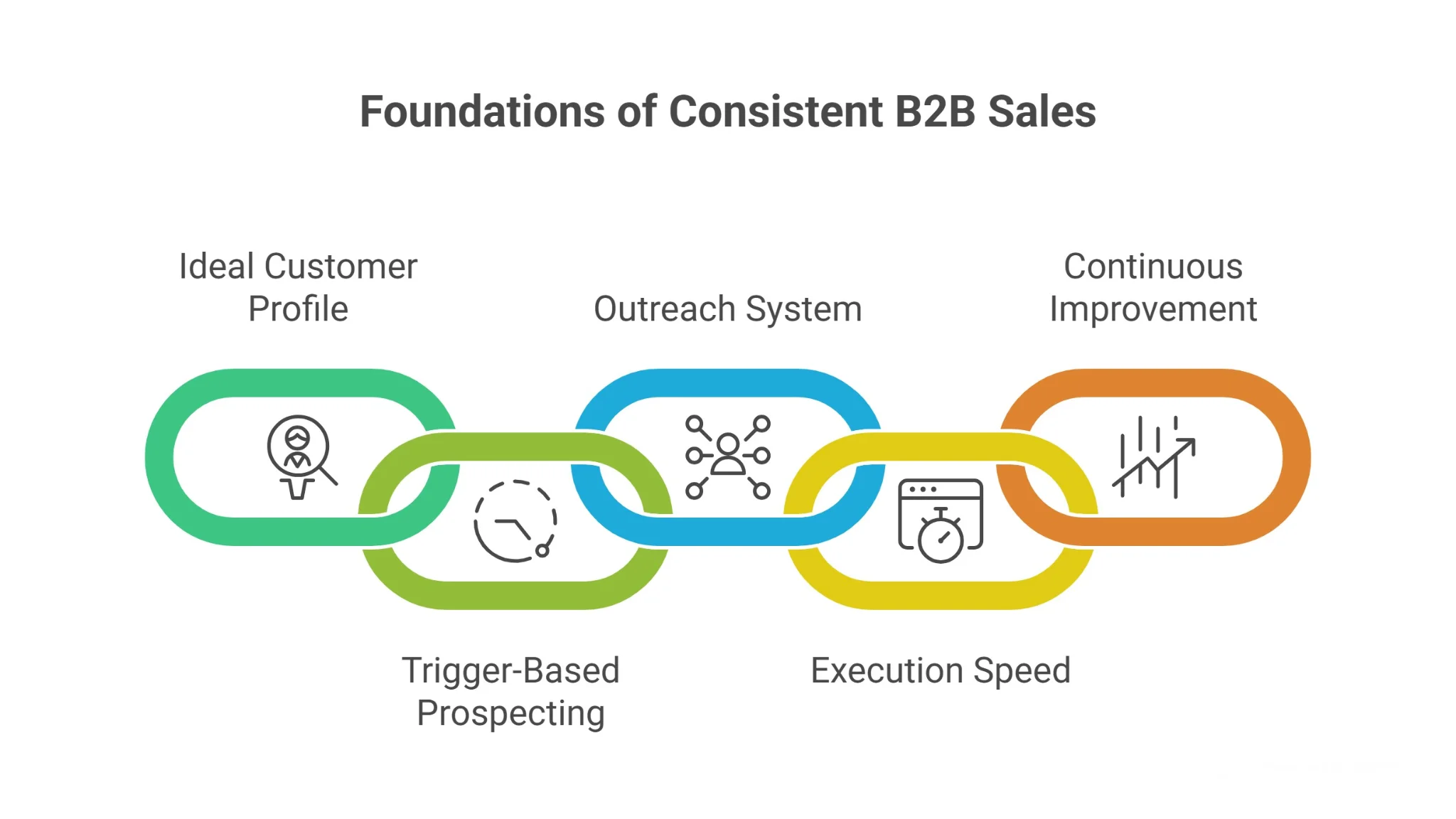
Now that you know what goes wrong, the next step is building the right foundation.
If you want to increase B2B sales consistently, you need a system that focuses on clarity, timing, execution, and continuous improvement.
These core elements make your sales process predictable instead of random.
Define a Clear and Focused Ideal Customer Profile
Everything starts with knowing exactly who you want to reach.
A well-defined ICP helps you focus your efforts on prospects who actually need your solution.
This improves targeting, increases relevance, and makes your outreach far more effective over time.
Use Timing and Trigger-Based Prospecting
Reaching out at the right moment can completely change your results.
Instead of contacting prospects randomly, you focus on signals like hiring activity, funding, or expansion.
This makes your outreach feel timely and increases the chances of getting a response.
Build a Consistent Outreach and Follow-Up System
Consistency is what turns effort into results.
A structured outreach system ensures that every lead is contacted properly and followed up without gaps.
It also helps you stay organized while improving engagement across multiple touchpoints.
Improve Speed of Execution Across the Funnel
Speed plays a bigger role than most teams realize.
When you respond quickly and launch campaigns without delays, you stay ahead of competitors.
Faster execution keeps momentum high and helps you engage prospects while their interest is still fresh.
Use Data and Feedback to Continuously Improve
Sales is not a one-time setup.
You need to constantly analyze what’s working and what isn’t.
Tracking performance and refining your approach helps you build a system that improves over time and drives consistent growth.
12 Proven Strategies to Increase B2B Sales Faster
Once your foundation is in place, execution is what actually drives results.
These strategies are focused on helping you increase B2B sales faster by improving how you target, communicate, and follow up.
Each one is simple to apply but powerful when used consistently.
1. Narrow Your ICP More Than Feels Comfortable
One of the biggest reasons teams struggle to grow is because their targeting is too broad.
It feels safe to go after a large market, but it actually reduces clarity in your messaging and lowers conversion rates.
When you narrow your ICP, you create focus.
Instead of saying “we help businesses,” you define exactly who you help—specific industry, role, company size, and even stage of growth.
This level of clarity makes everything easier.
Your messaging becomes sharper, your outreach feels more relevant, and your prospects are more likely to respond because it feels tailored to them.
A smaller ICP doesn’t limit growth—it improves efficiency and makes scaling easier over time.
2. Use Trigger-Based Prospecting Instead of Cold Lists
Most cold outreach fails because it ignores timing.
You might have the right prospect, but if you reach out at the wrong moment, your message gets ignored.
Trigger-based prospecting solves this by aligning your outreach with real-world signals.
These signals can include:
- Hiring for a specific role
- Recent funding or expansion
- Leadership or team changes
When you reach out based on these triggers, your message feels timely and relevant.
Instead of sounding like a cold pitch, it feels like a helpful conversation tied to something they are already dealing with.
This shift alone can significantly improve reply rates and help you start better conversations.
3. Improve Your First Message Before Scaling
Many teams try to scale outreach before fixing their messaging.
This usually leads to poor results at a larger scale.
Your first message is the entry point to every opportunity, so it needs to work before you increase volume.
A strong message is simple, clear, and focused.
It doesn’t try to explain everything or sell too much upfront.
Instead, it creates curiosity and relevance.
Focus on:
- One clear problem your prospect relates to
- A short and direct message structure
- An easy way for them to respond
When your first message starts generating consistent replies, scaling becomes much more effective and predictable.
4. Qualify Leads Before Spending Too Much Time
Not every lead deserves equal attention.
Spending too much time on low-fit prospects slows down your pipeline and reduces overall efficiency.
Qualification helps you focus only on leads that have a real chance of converting.
Early in the process, you should evaluate whether the prospect fits your ICP and has a genuine need for your solution.
This includes understanding:
- Whether they have the problem you solve
- If they are in a position to make or influence decisions
- Whether there is a realistic timeline for action
By filtering early, you avoid wasting effort and can spend more time on high-quality opportunities that move forward faster.
5. Ask Better Discovery Questions to Understand Buyer Needs
Once you’re speaking with a prospect, your goal is not to pitch immediately.
It’s to understand.
Better discovery leads to better positioning.
Instead of asking surface-level questions, go deeper into their current situation.
Focus on uncovering:
- What challenges they are facing right now
- How they are currently solving those challenges
- Where their current approach is falling short
These insights allow you to connect your solution directly to their needs.
When prospects feel understood, they are more open to your recommendations and more likely to move forward.
6. Build a Consistent Sales Process Across the Funnel
Without a defined process, your sales efforts become inconsistent.
Each deal moves differently, follow-ups get missed, and it becomes harder to predict outcomes.
A structured sales process brings clarity and control.
You define clear stages—from initial outreach to qualification, discovery, proposal, and closing.
Each stage has a purpose and a set of actions that move the deal forward.
This consistency helps in multiple ways:
- Your team knows exactly what to do at each stage
- Deals move more smoothly without confusion
- Performance becomes easier to track and improve
A well-defined process doesn’t make sales rigid.
It makes execution reliable.
When your system is consistent, you can scale your efforts without losing quality, and your ability to increase B2B sales becomes much more predictable over time.
7. Shorten Response Time at Every Sales Stage
Once a prospect shows interest, speed becomes your biggest advantage.
Most deals are not lost because of poor messaging, but because of slow responses.
When there’s a delay between actions—whether it’s replying to an email, following up after a call, or sending a proposal—you lose momentum.
And in B2B sales, lost momentum often means lost deals.
Fast response times show professionalism and intent.
They signal to the prospect that you are reliable and serious about helping them.
To improve speed, focus on:
- Responding to inbound replies within hours, not days
- Sending follow-ups while the conversation is still fresh
- Reducing delays between each stage of the process
The faster you move, the more likely you are to stay top of mind and move the deal forward.
8. Handle Objections Before They Stall the Deal
Objections are not a problem—they are a signal.
They show that the prospect is thinking seriously about your solution.
The mistake most teams make is reacting too late or handling objections poorly.
Instead of waiting for objections to appear at the end, address them early in the process.
Common objections usually revolve around price, timing, trust, or fit.
If you prepare for them in advance, you can respond with clarity and confidence.
A strong approach includes:
- Identifying common objections in your sales cycle
- Preparing simple, direct responses
- Addressing concerns before they become blockers
When objections are handled smoothly, deals keep moving instead of getting stuck.
9. Make Your Proposal and Next Steps Easy to Understand
Even after a strong sales conversation, deals often slow down at the proposal stage.
This usually happens because the proposal is unclear or overwhelming.
If a prospect has to spend too much time understanding your offer, they delay the decision.
Clarity removes friction.
Your proposal should be simple, structured, and focused on value.
It should clearly answer three questions:
- What are you offering?
- Why does it matter to them?
- What happens next?
Avoid unnecessary complexity.
The easier it is to understand your proposal, the faster prospects can make a decision and move forward.
10. Improve Deal Closing Consistency
Closing deals should not feel unpredictable.
If your results vary widely, it usually means your process lacks structure.
Consistent closing comes from alignment, not pressure.
You need to understand how the prospect makes decisions and guide them through that process.
This includes:
- Identifying all decision-makers early
- Confirming goals and expectations clearly
- Setting realistic timelines for closing
When everything is aligned, closing becomes a natural next step rather than a forced outcome.
Consistency at this stage increases your overall conversion rate and builds a more predictable pipeline.
11. Focus on Pipeline Movement, Not Just Activity
It’s easy to measure activity.
You can track emails sent, calls made, or meetings booked.
But these metrics don’t always reflect real progress.
What matters is how deals move through your pipeline.
If deals are getting stuck at certain stages, that’s where your attention should go.
Instead of focusing only on volume, focus on movement.
Ask yourself:
- Which stage has the most drop-offs?
- Where are deals slowing down?
- What actions can move them forward?
When you optimize for movement, your pipeline becomes healthier and more efficient.
12. Improve Retention and Expansion Alongside New Sales
Many teams focus only on acquiring new customers.
But long-term growth comes from what happens after the deal is closed.
Retention and expansion are often easier and more profitable than constant new acquisition.
Once a customer starts seeing value, they are more open to continuing and expanding the relationship.
To improve retention and growth:
- Stay engaged after the sale
- Regularly check in on results and satisfaction
- Identify opportunities for upselling or cross-selling
This approach increases customer lifetime value and reduces dependency on new leads.
When you balance new sales with retention and expansion, your revenue becomes more stable and scalable.
How Oppora Helps You Increase B2B Sales with Better Execution
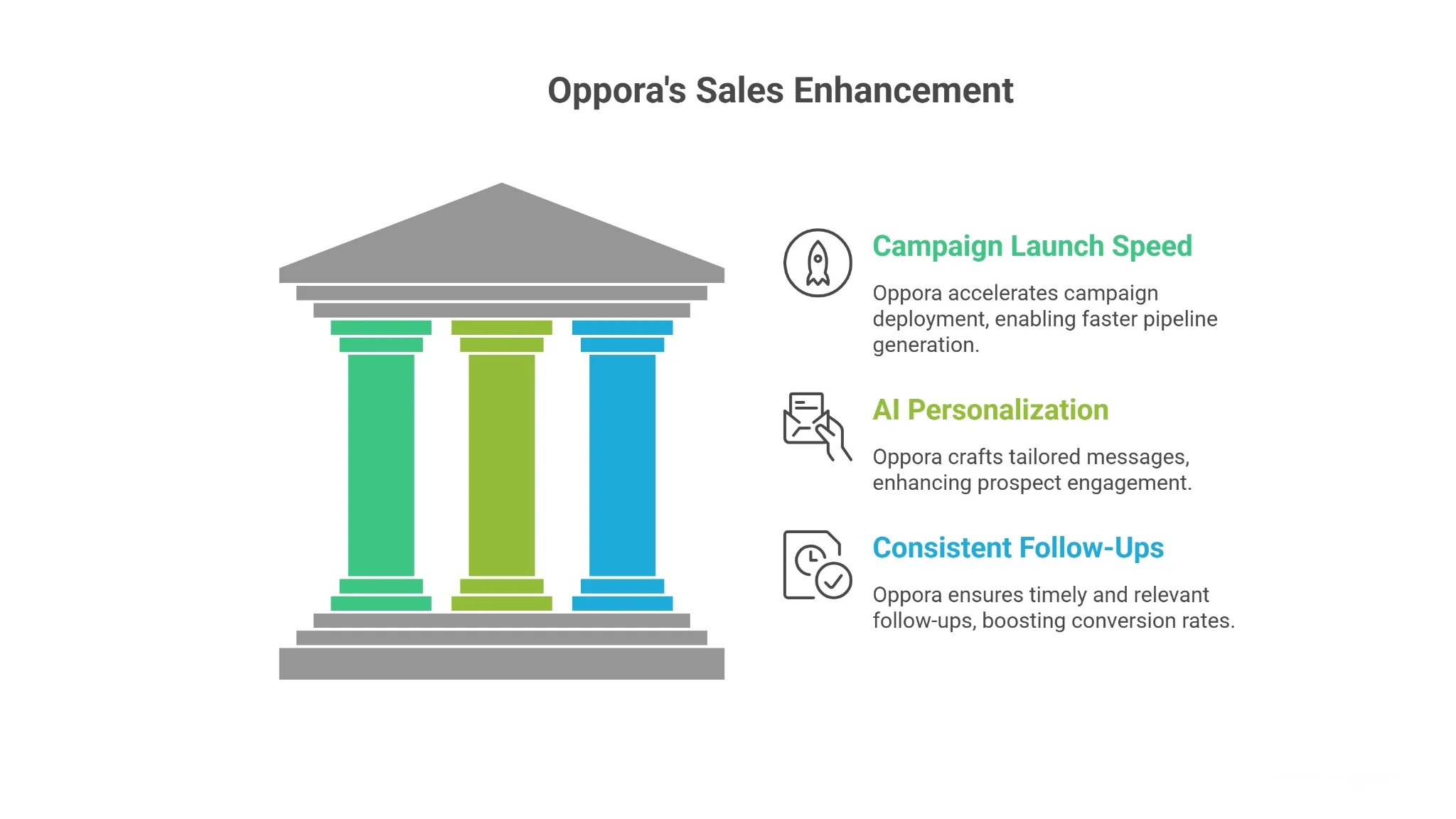
Even with the right strategy, execution is where most teams struggle.
Managing leads, writing emails, following up, and tracking performance manually slows everything down and creates inconsistency.
This is where Oppora changes how outbound works.
Oppora is an AI outbound sales agent that handles your entire sales workflow—from finding the right leads to sending emails, following up, and even replying to prospects.
Instead of juggling multiple tools, you build one system, and Oppora keeps it running automatically.
Build and Launch Campaigns Faster
Launching campaigns manually takes time and often delays pipeline generation.
With Oppora, you can go from idea to execution much faster without dealing with complex setup.
It helps you:
- Find and target the right prospects automatically
- Generate complete outreach sequences
- Launch campaigns without manual coordination
This speed allows you to start conversations earlier and stay ahead of competitors.
AI Personalize Outreach Without Manual Effort
Personalization is critical, but doing it manually doesn’t scale.
Oppora uses AI to generate context-aware messages for each prospect, making your outreach feel relevant without requiring hours of effort.
Each message is tailored based on the lead’s profile, helping you improve response rates while keeping your process efficient.
This means you can scale outreach without sacrificing quality.
Keep Follow-Ups Consistent Automatically
Follow-ups are where most conversions happen, but they are also the easiest to miss.
Oppora ensures every lead is followed up at the right time with the right message.
It automatically:
- Sends follow-ups based on timing and behavior
- Adjusts messaging across touchpoints
- Keeps communication consistent without manual tracking
This consistency helps you stay visible, build trust, and convert more prospects into real sales conversations.
Common Mistakes That Slow Down B2B Sales Growth
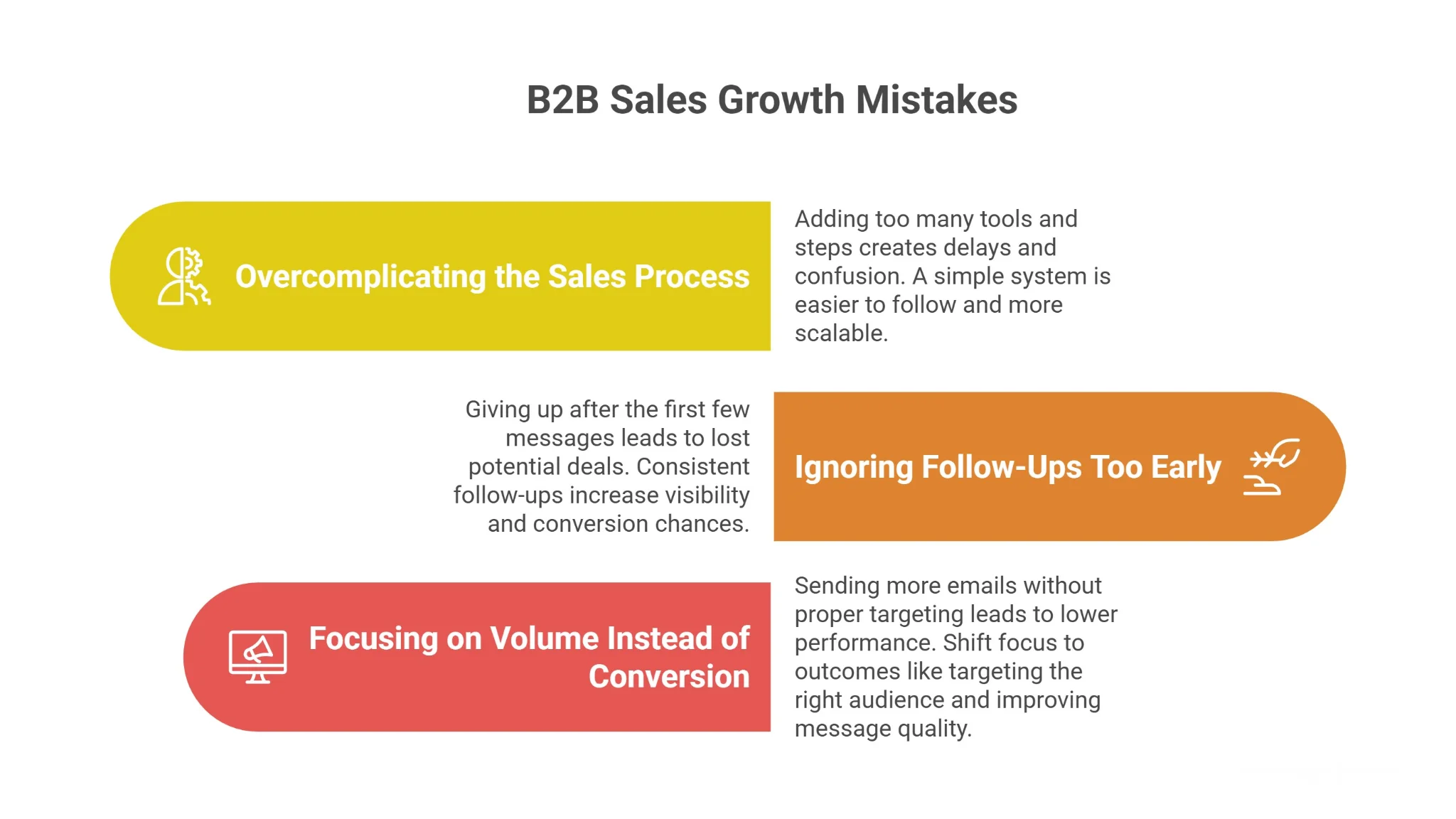
Even with the right strategies in place, small mistakes in execution can slow everything down.
These issues often go unnoticed but have a direct impact on your ability to increase B2B sales consistently.
Fixing them doesn’t require more effort—it requires better focus and simplification.
Overcomplicating the Sales Process
Many teams believe adding more tools, steps, or workflows will improve results.
In reality, complexity creates delays and confusion.
When your process becomes harder to manage, execution slows down and opportunities get missed.
A simple system is easier to follow, faster to execute, and more scalable.
The goal is not to do more, but to do the right things consistently without friction.
Ignoring Follow-Ups Too Early
One of the biggest mistakes is giving up after the first or second message.
Most prospects don’t respond immediately, not because they’re not interested, but because timing isn’t right.
When you stop follow-ups too early, you lose potential deals that could have converted later.
Consistent follow-ups help you stay visible and increase your chances of turning initial interest into real conversations.
Focusing on Volume Instead of Conversion
It’s easy to assume that sending more emails will increase results.
But without proper targeting and messaging, higher volume often leads to lower performance.
Instead of focusing only on activity, shift your focus to outcomes.
This means:
- Targeting the right audience instead of everyone
- Improving message quality instead of sending more
- Optimizing for replies and conversations, not just outreach numbers
When you focus on conversion, your efforts become more efficient and your pipeline becomes stronger.
Conclusion: A Simple System to Increase B2B Sales Consistently
Increasing B2B sales doesn’t come from doing more it comes from doing the right things consistently.
When you focus on clear targeting, simple messaging, timely outreach, and structured follow-ups, your sales process becomes predictable and scalable.
The key is building a system that runs without constant manual effort.
If you’re looking to simplify execution and turn your strategy into a working system, tools like Oppora can help you connect everything—from prospecting to outreach to follow-ups—so your pipeline keeps growing without added complexity.
Frequently Asked Questions (FAQs)
What is the fastest way to increase B2B sales without increasing ad spend?
The fastest way is to improve targeting and outreach quality. Focus on a well-defined ICP, use trigger-based prospecting, and optimize messaging. When you reach the right prospects with relevant timing and clear value, you can increase B2B sales without spending more on ads or scaling volume.
How long does it usually take to see results in B2B sales improvement?
Results depend on your current system, but most teams start seeing improvements in reply rates within 2–3 weeks after optimizing targeting and messaging. Consistent follow-ups and structured outreach systems typically lead to noticeable pipeline growth within one sales cycle.
What matters more in B2B sales—personalization or volume?
Personalization matters significantly more than volume. Sending fewer but highly relevant messages leads to better engagement and higher conversion rates. Volume without relevance usually reduces deliverability and response quality, while personalized outreach builds trust and increases meaningful conversations.
How important is timing in B2B outreach success?
Timing is critical in B2B sales. Reaching prospects during triggers like hiring, funding, or expansion increases response probability. Even a well-written message may fail if sent at the wrong time, while timely outreach can significantly improve engagement and conversion rates.
Can small teams compete with larger sales organizations?
Yes, small teams can compete effectively by using focused targeting, automation, and efficient workflows. With the right system, they can move faster than larger teams and maintain higher personalization, allowing them to generate strong pipelines without needing large sales resources.