Warm Regards vs Best Regards: Choosing the Right Email Sign-Off
You’ve written the perfect email—sharp subject line, clear message, compelling offer.
Then comes the final line: the sign-off.
Warm regards? Best regards? Kind regards?
It may seem like a small detail, but this tiny line can subtly influence how your message is perceived. Sign-offs shape tone, professionalism, and even response rates.
You could spend hours perfecting your email—researching the prospect, refining your pitch, personalizing every line—and then end it with: “Warm regards” or “Best regards.”
Seems minor, right? Not really.
Your sign-off is the emotional closing of your message. It tells the recipient:
- How formal you are
- How well you know them
- What kind of relationship you expect
In outbound, networking, and professional communication, this choice can either reinforce trust—or create friction.
Let’s break it down so you can use the right sign-off intentionally, every time.
What Does “Warm Regards” Mean in an Email?
“Warm regards” is a semi-formal sign-off with emotional undertone.
It communicates:
- Friendliness
- Appreciation
- A degree of familiarity
- Openness to continued interaction
Unlike purely professional closings, it adds a human layer—but without crossing into casual territory.
The nuance most people miss:
“Warm” doesn’t just mean polite—it implies some level of relationship or goodwill already exists.
Where it fits naturally:
- Ongoing conversations
- Client relationships
- Partnerships
- Internal team communication
Example (context-aware):
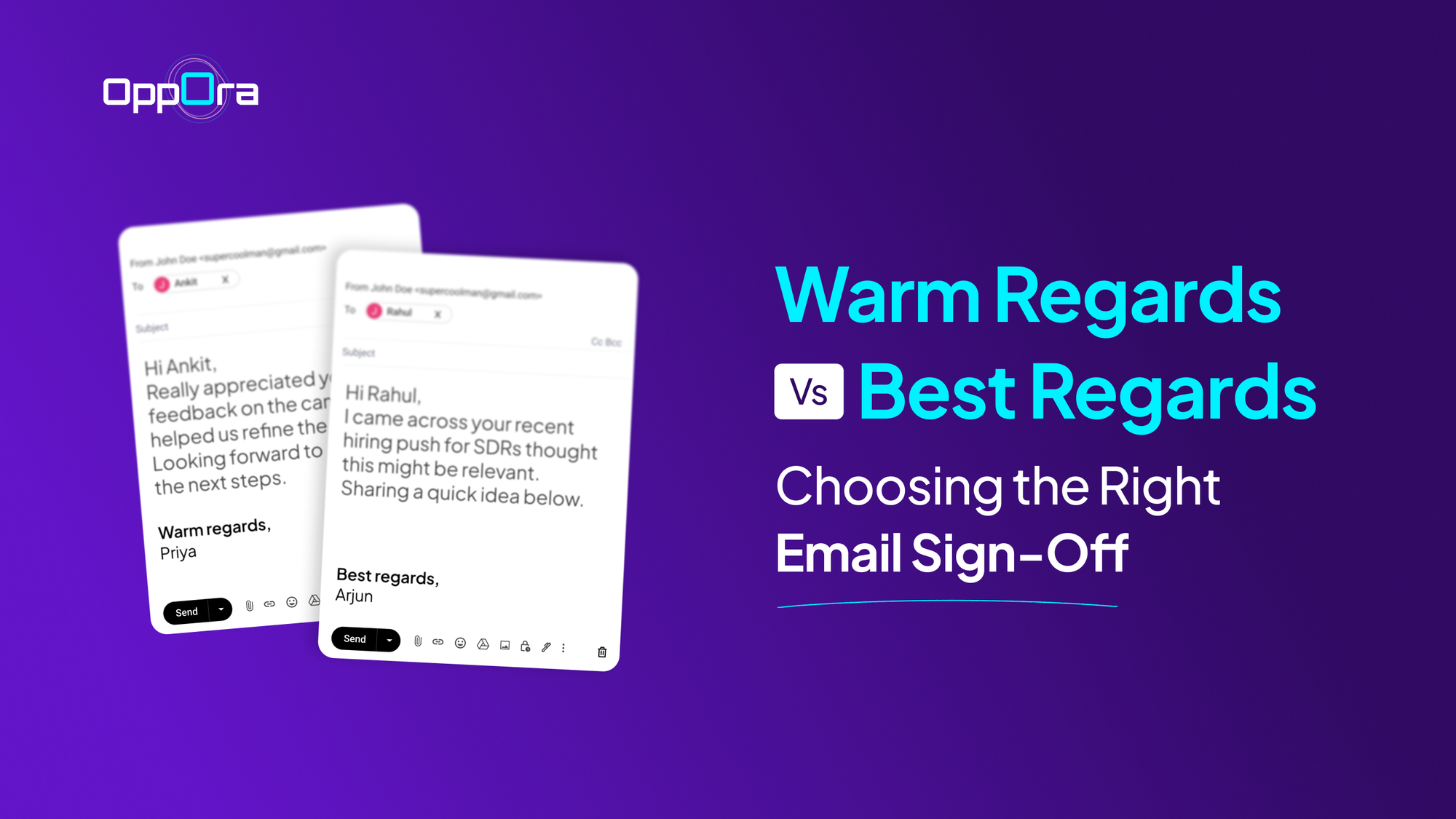
Hi Ankit,
Really appreciated your feedback on the campaign—it helped us refine the targeting.
Looking forward to the next steps.
Warm regards,
Priya
Here, “warm regards” works because:
- There’s prior interaction
- The tone is collaborative
- It reinforces relationship continuity
Where it can go wrong:
Using it in a first cold email can feel:
- Slightly presumptuous
- Overly familiar
- Artificial
What Does “Best Regards” Mean in an Email?
“Best regards” is a neutral, professional, and universally accepted sign-off.
It communicates:
- Respect
- Professionalism
- Politeness without emotional assumption
Why it’s the default:
It works across almost every scenario because it doesn’t assume:
- Relationship depth
- Emotional tone
- Familiarity
Where it fits best:
- Cold emails
- First-time introductions
- Business proposals
- Formal communication
Example:
Hi Rahul,
I came across your recent hiring push for SDRs—thought this might be relevant.
Sharing a quick idea below.
Best regards,
Arjun
Here, “best regards” works because:
- It keeps things professional
- Doesn’t assume familiarity
- Matches the intent of outreach
Key insight:
“Best regards” is not cold—it’s balanced.
When to Use Warm Regards
Choosing “warm regards” should be intentional—not automatic.
It works best when your email has moved beyond a purely transactional interaction and there’s some level of familiarity or trust.
At its core, it signals:
- A shift from formal → more personal
- You recognize the recipient beyond just the task
- The conversation is ongoing, not one-off
1. After Multiple Conversations (Relationship Progression)
As conversations progress, your tone should evolve too.
Use it when:
- There’s back-and-forth replies
- The recipient engages meaningfully
- You’re past the initial outreach stage
Why it works:
- Reflects natural communication
- Reduces “cold” tone
- Signals growing rapport
Example:
Hi Rahul, Glad this aligns—sharing a few ideas below.
Warm regards,
Avoid if: interaction is still minimal or formal.
2. Client Communication (Building Trust)
With clients, tone plays a role in long-term relationships.
Use it when:
- Sending updates or reports
- Managing ongoing work
- Communicating regularly
Why it works:
- Adds a human touch
- Reinforces partnership, not just service
Example:
Hi Kavya, Sharing this week’s report and next steps.
Warm regards,
3. Collaborative Discussions (Working With, Not Selling)
When communication is collaborative, not transactional, tone should reflect that.
Use it when:
- Brainstorming ideas
- Working with teams or partners
- Discussing strategies
Why it works:
- Feels less rigid
- Encourages open communication
4. Follow-Ups After Positive Engagement
If someone shows interest, your tone should match that energy.
Use it when:
- A prospect replies positively
- Conversations are moving forward
Why it works:
- Feels natural and aligned
- Strengthens momentum
Example:
Hi Neha, Great to hear this resonates—sharing next steps below.
Warm regards
When to Use Best Regards
“Best regards” is the safest and most versatile email sign-off.
It works best when your communication is still formal, neutral, or early-stage, where you don’t want to assume familiarity.
At its core, it signals:
- Professionalism without being too stiff
- Respect without emotional tone
- A neutral starting point for any conversation
1. First-Time Emails (Cold Outreach or Introductions)
This is where “best regards” performs best.
Use it when:
- Reaching out to someone for the first time
- Sending cold emails or sales outreach
- Introducing yourself or your company
Why it works:
- Doesn’t assume familiarity
- Keeps tone professional and safe
- Builds credibility early on
Example:
Hi Arjun, Came across your recent hiring post—thought this might be relevant.
Best regards
2. Formal or Professional Communication
When the context is more structured, your tone should match it.
Use it when:
- Sending proposals or official documents
- Communicating with senior stakeholders
- Writing in corporate or formal settings
Why it works:
- Maintains professionalism
- Avoids sounding too casual or personal
3. When You’re Unsure About Tone
If you’re ever in doubt—default to “best regards.”
Use it when:
- You don’t know the recipient well
- The tone of conversation is unclear
- You want to avoid overstepping
Why it works:
- Universally accepted
- Rarely feels out of place
- Keeps communication balanced
4. Early Stages of a Conversation
Even after the first email, it’s often better to stay neutral initially.
Use it when:
- You’ve only exchanged 1–2 emails
- The relationship is still developing
- Engagement is limited
Why it works:
- Prevents forced familiarity
- Keeps tone consistent
- Gives space for natural progression
Example:
Hi Neha,
Thanks for the quick response—sharing more details below.
Best regards
Warm Regards vs Best Regards: Detailed Comparison
How to Maintain the Right Tone at Scale
Choosing between “warm regards” and “best regards” is simple when you're writing a few emails.
But in real outbound workflows, you’re often dealing with:
- Dozens (or hundreds) of prospects daily
- Different stages of conversations
- Varying levels of familiarity
And this is where most teams struggle.
They either:
- Stick to one sign-off (losing nuance), or
- Manually adjust tone (which doesn’t scale)
This is exactly the kind of problem Oppora.ai, a smart outbound automation platform, is designed to solve.
Instead of treating emails as isolated messages, Oppora helps you:
- Adapt messaging based on conversation stage
- Keep tone consistent across sequences
- Personalize emails without making them feel forced or robotic
So instead of constantly wondering:
“Should I use warm regards or best regards here?”
You’re working within a system where:
- Early-stage emails stay neutral and professional
- Follow-ups naturally become more contextual and human
With this approach, every email—down to the sign-off—feels intentional, consistent, and relationship-aware.
How Oppora Works to Keep Your Email Tone Consistent
Oppora.ai isn’t just an automation tool—it’s a smart outbound assistant that helps you manage conversations at scale without losing the human touch. Here’s how it works:
- Context-Aware Messaging
- Tracks where each prospect is in your email sequence
- Recognizes if it’s a first outreach, a follow-up, or a response to a positive engagement
- Suggests or standardizes the right tone and sign-off (e.g., “best regards” for first emails, “warm regards” for ongoing conversations)
- Dynamic Personalization
- Personalizes emails at scale without manual rewriting
- Adapts greetings, content, and closings based on prior interactions
- Ensures every message feels tailored and natural
- Tone Consistency Across Sequences
- Maintains consistent tone across dozens or hundreds of emails
- Prevents mistakes like using casual sign-offs too early or overly formal language in later emails
- Automation with Oversight
- Automates repetitive tasks while allowing review and tweaks
- Balances efficiency with a human touch for professional, approachable messages
- Insights and Optimization
- Tracks engagement metrics to see what messaging and sign-offs work best
- Helps refine your outreach strategy over time for higher response rates
Conclusion: Make Every Email Sign-Off Intentional
Choosing the right sign-off is more than a formality—it’s a subtle way to signal professionalism, familiarity, and tone.
- Use “Best regards” for first-touch emails, formal communications, or when you want to maintain a neutral, professional tone.
- Use “Warm regards” once rapport is established, in ongoing conversations, or when your goal is to build a personal connection.
At scale, these small details can become hard to manage—but with tools like Oppora.ai, you can:
- Keep your tone consistent across hundreds of emails
- Personalize messages without losing efficiency
- Ensure every email feels intentional, professional, and human
Take Action
Stop worrying about whether your sign-off is appropriate. Let Oppora.ai help you automate outreach, adapt tone by conversation stage, and scale your email communication without losing that personal touch.
👉 Try Oppora.ai today and make every email count
Frequently Asked Questions
When should I switch from “Best regards” to “Warm regards”?
Once you’ve exchanged a few meaningful emails, built rapport, or engaged in collaborative discussions, moving to “Warm regards” signals growing familiarity.
Is “Kind regards” different from “Warm regards” and “Best regards”?
Yes. Kind regards sits between the two: more personal than Best regards, but slightly more formal than Warm regards. It’s often used when you want polite friendliness without implying deep familiarity.
Can I mix sign-offs within the same email thread?
It’s best to maintain consistency within a thread. Switching between Warm regards and Best regards mid-thread can confuse tone or create mixed signals.
How do I maintain consistent sign-offs across my team?
Tools like Oppora.ai can standardize tone and sign-offs across sequences, ensuring your team uses the right closing for every prospect and stage of conversation.