11 Best Waterfall Enrichment Tools Compared (2026)

Finding leads isn't the hard part anymore. Finding complete, accurate, and verified contact data is.
You might use a lead generation platform that gives you a company name but no email address. Another tool finds an email but can't verify it. A third platform has a phone number but no LinkedIn profile.
Switching between multiple providers wastes time and often leaves your prospect list incomplete.
That's why more sales teams are turning to waterfall enrichment tools.
Instead of relying on a single data provider, these tools automatically check multiple databases one after another until they find the best available contact information.
The result is better data coverage, fewer missing records, and higher-quality prospects for your outreach campaigns.
Whether you're building outbound lists, enriching CRM records, or improving email deliverability, choosing the right enrichment platform can make a significant difference.
In this guide, you'll learn:
- What waterfall enrichment is and how it works
- Why businesses are adopting waterfall enrichment tools
- The 11 best waterfall enrichment tools available today
- What to look for before choosing the right platform
What Is Waterfall Enrichment?
Traditional enrichment relies on a single provider, which often leads to missing emails, phone numbers, or incomplete records.
Waterfall enrichment solves this by checking multiple data providers in sequence until it finds verified contact information. If one source doesn't return a match, the platform automatically moves to the next.
Think of it as searching multiple libraries instead of relying on just one.
Lead → Provider A → No Match → Provider B → No Match → Provider C → Verified Email Found
Most modern waterfall enrichment tools can enrich work emails, phone numbers, LinkedIn profiles, company data, job titles, buying signals, and firmographic information. Some also keep CRM records updated automatically.
The biggest benefit is simple: you get more complete and accurate prospect data with less manual effort.
How We Selected These Waterfall Enrichment Tools
Not every enrichment platform works the same way.
Some simply connect to one database, while others use sophisticated waterfall logic across several providers. To create this list, we evaluated each tool based on the factors that matter most for modern sales teams.
Our comparison considered:
- Number of enrichment providers
- Waterfall enrichment capabilities
- Email verification accuracy
- Bulk enrichment support
- CRM integrations
- API availability
- Automation features
- Ease of use
- Pricing flexibility
- Overall value for outbound sales
Some platforms excel at enterprise enrichment, while others focus on affordable email discovery or AI-powered workflows.
The right choice ultimately depends on your sales process, team size, and budget.
11 Best Waterfall Enrichment Tools Compared
No enrichment platform works the same way. Some focus purely on contact discovery, while others combine waterfall sourcing, verification, and outbound automation. Here's how the top tools compare.
1. Oppora.ai
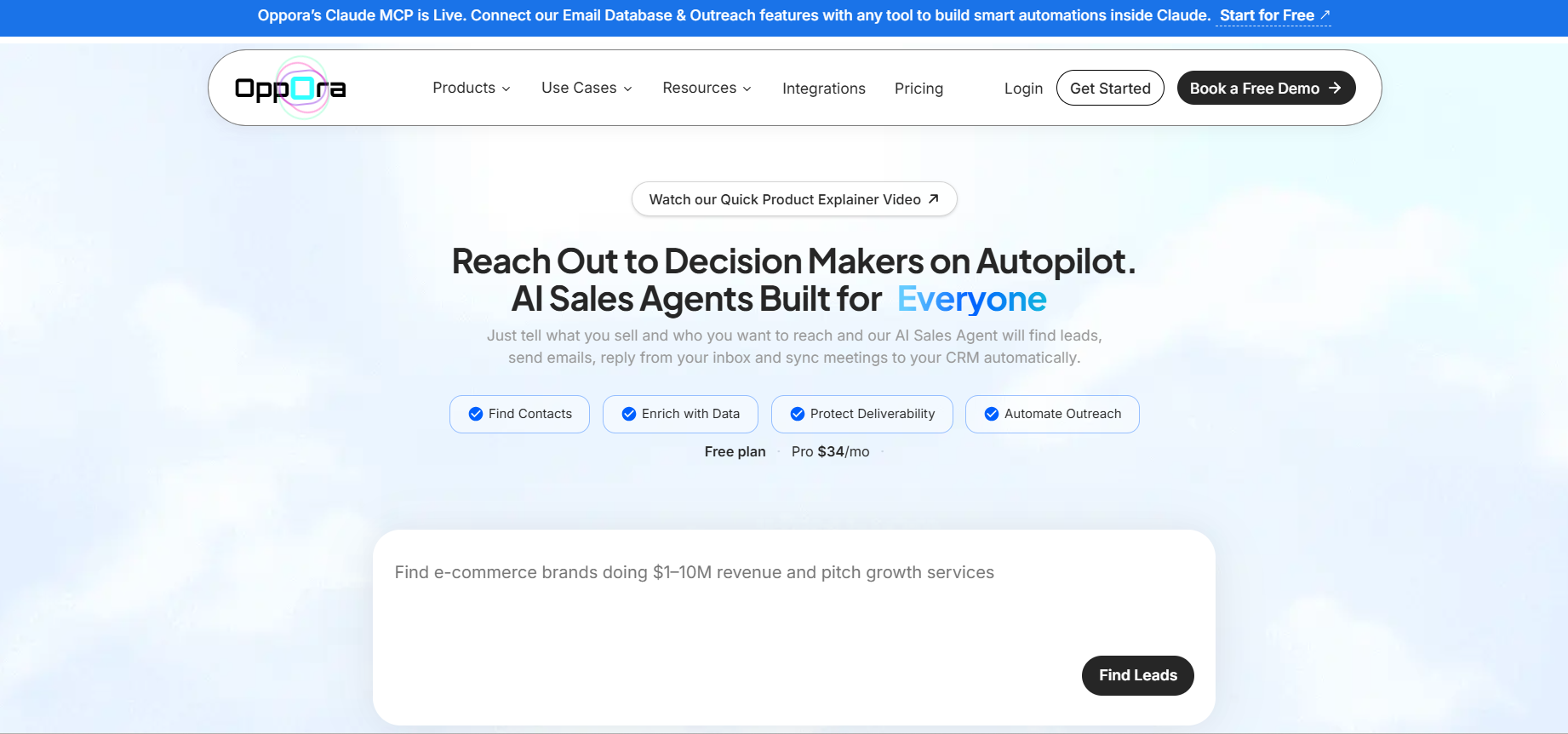
Best for: Teams looking for a waterfall enrichment platform with built-in prospecting and outbound capabilities.
Oppora is an AI-powered sales platform that combines prospecting, waterfall enrichment, verification, and outbound workflows in one place.
Unlike tools that rely on a single provider, Oppora.ai uses a waterfall methodology that checks multiple data sources to improve match rates and reduce incomplete records.
Its internal database includes 1B+ verified contacts and 60M+ companies, enriched with data from LinkedIn, company websites, business directories, and public datasets.
Teams can further expand their enrichment coverage by connecting external providers like Apollo, ContactOut, Prospeo, Hunter, and other APIs, making it easier to find verified emails, phone numbers, and hard-to-source contacts.
Oppora also provides 20+ buying signals, firmographic data, company insights, and built-in email verification to help sales teams prioritize and validate prospects more effectively.
Pros
- Waterfall enrichment across multiple data providers
- Internal database with 1B+ verified contacts
- Access to 60M+ companies
- Support for external providers like Apollo, ContactOut, Prospeo, and Hunter
- Finds both verified emails and phone numbers
- Company and lead search capabilities
- Sources data from LinkedIn, company websites, and business databases
- Access to 20+ buying signals
- Built-in email verification
- Separate credits for search, enrichment, and verification
- Native CRM integrations
Cons
- The extensive AI automation features may be more than very small teams or businesses with simple enrichment needs require.
Pricing: Free plan available. Paid plans start at $34/month and include 10,000 data credits, 200 phone credits, and access to 1B+ contacts and 60M+ companies.
2. Clay
Best for: Sales teams that want highly customizable lead enrichment and workflow automation.
Clay is a popular sales intelligence platform that lets you enrich prospect data using multiple third-party providers through customizable workflows.
Instead of manually checking different enrichment services, you can build waterfall logic that automatically searches multiple data sources to improve match rates and complete missing records.
One of Clay's biggest strengths is its flexibility. You can combine enrichment providers, AI prompts, web scraping, and custom formulas into a single workflow.
This makes it a great choice for teams that need highly personalized prospecting and outbound campaigns.
However, Clay has a steeper learning curve than most enrichment tools. Setting up advanced workflows takes time, and costs can increase quickly if you're enriching large datasets using multiple providers.
Pros
- Supports multiple enrichment providers
- Highly customizable workflows
- AI-powered data processing
- Extensive integrations with CRM and sales tools
- Strong automation capabilities
Cons
- Steeper learning curve for beginners
- Usage costs can grow quickly with large enrichment volumes
Pricing: Free plan available. Paid plans start from approximately $149/month.
Suggested Reading:
Clay vs Apollo: Full Comparison + Best Pick for You3. Apollo.io
Best for: Teams looking for an all-in-one sales intelligence and outreach platform.
Apollo.io combines a large B2B contact database with prospecting, email outreach, and CRM features.
It allows users to discover companies, find decision-makers, and enrich lead information without switching between multiple sales tools.
While Apollo offers contact enrichment and email verification, it primarily relies on its own database rather than a true multi-provider waterfall enrichment model.
This makes it a solid option for general prospecting, but teams looking for maximum contact coverage may benefit from dedicated waterfall enrichment platforms.
Apollo also includes email sequencing, call tracking, Chrome extensions, and CRM integrations, making it a popular choice for growing sales teams.
Pros
- Large B2B contact database
- Built-in email outreach
- Email verification
- CRM integrations
- Easy-to-use interface
Cons
- Limited waterfall enrichment compared to specialized tools
- Data accuracy can vary across industries
Pricing: Free plan available. Paid plans start from approximately $59/user/month.
4. FullEnrich
Best for: Businesses focused on maximizing email match rates through waterfall enrichment.
FullEnrich is designed specifically for waterfall enrichment.
Instead of depending on one contact database, it automatically searches multiple enrichment providers until it finds a verified email address, helping sales teams achieve much higher match rates.
The platform focuses on email discovery and verification rather than becoming a complete outbound sales platform.
This makes it a strong choice if you already use separate tools for prospecting and outreach but need better enrichment results.
Its simple interface and API support also make it easy to integrate into existing sales workflows.
Pros
- True multi-provider waterfall enrichment
- High email match rates
- Built-in verification
- API support
- Easy to use
Cons
- Primarily focused on enrichment only
- Limited campaign and outreach features
Pricing: Custom pricing based on usage.
5. BetterContact
Best for: Startups and sales teams looking for affordable waterfall email enrichment.
BetterContact helps improve contact coverage by automatically checking multiple email providers until it finds the best available result.
The platform focuses on delivering verified work email addresses while reducing wasted enrichment credits.
Its clean interface, API access, and integration with popular sales tools make it suitable for businesses that need reliable enrichment without investing in a larger sales engagement platform.
Because of its affordable pricing, it's particularly attractive for startups and smaller outbound teams.
While BetterContact excels at email enrichment, it offers fewer built-in sales automation features than comprehensive outbound platforms.
Pros
- Multi-provider waterfall enrichment
- Affordable pricing
- Email verification support
- API access
- Easy implementation
Cons
- Limited sales engagement features
- Focused mainly on contact enrichment
Pricing: Free trial available with paid plans based on usage.
6. Persana AI
Best for: AI-powered prospecting and lead enrichment.
Persana AI combines lead discovery, enrichment, and AI-driven prospect research into a single platform.
It gathers data from multiple sources to enrich contacts with company information, verified emails, buying signals, and other insights that help sales teams prioritize high-value prospects.
Beyond enrichment, Persana uses AI to identify ideal customers, personalize outreach, and automate repetitive prospecting tasks.
This makes it a strong option for teams that want to combine enrichment with intelligent lead scoring and sales automation.
Pros
- AI-powered lead enrichment
- Multiple data sources
- Buying intent and prospect insights
- CRM integrations
- Automated prospect research
Cons
- Advanced AI features can take time to master
- Pricing may be expensive for smaller teams
Pricing: Custom pricing with free trial available.
7. Dropcontact
Best for: GDPR-compliant contact enrichment for European businesses.
Dropcontact focuses on enriching professional contact data while maintaining strong privacy compliance.
Instead of relying on massive contact databases, it rebuilds and verifies business contact information using publicly available data, making it a popular choice for companies operating in Europe.
The platform enriches emails, job titles, company information, and LinkedIn profiles while automatically cleaning duplicate or outdated records.
It also integrates well with CRMs and sales engagement platforms to keep contact databases updated.
Pros
- GDPR-friendly approach
- Automatic contact enrichment
- Email verification
- CRM integrations
- Database cleaning and deduplication
Cons
- Smaller global coverage than some competitors
- Limited waterfall capabilities compared to dedicated enrichment platforms
Pricing: Paid plans start from approximately €24/month.
8. People Data Labs
Best for: Enterprises that need large-scale data enrichment through APIs.
People Data Labs (PDL) offers one of the largest B2B and B2C datasets available for developers and enterprise sales teams.
Its API-first approach makes it ideal for businesses that need to enrich millions of customer records or build custom sales intelligence applications.
Besides contact information, PDL provides company data, firmographics, demographics, technologies, skills, education, and employment history.
While it isn't a dedicated waterfall enrichment platform, many organizations include it as one of several providers in their enrichment workflows.
Pros
- Massive global dataset
- Powerful API
- Enterprise-grade scalability
- Rich person and company data
- Excellent developer documentation
Cons
- Technical setup required
- More suitable for enterprises than small businesses
Pricing: Free tier available with custom enterprise pricing.
9. Clearbit (Breeze Intelligence)
Best for: Company and account-based enrichment.
Clearbit, now part of HubSpot's Breeze Intelligence, is well known for enriching company and contact records using firmographic and technographic data.
It helps sales and marketing teams identify company size, industry, revenue, technologies used, and other business attributes that improve lead qualification.
Although Clearbit offers reliable enrichment, it focuses more on company intelligence than true multi-provider waterfall enrichment.
It's particularly valuable for account-based marketing (ABM) teams looking to enrich CRM records automatically.
Pros
- Strong company enrichment
- Reliable firmographic data
- CRM integrations
- Real-time enrichment
- Great for ABM strategies
Cons
- Limited waterfall enrichment functionality
- Better suited for company data than email discovery
Pricing: Custom pricing.
10. Proxycurl
Best for: Developers building custom enrichment workflows.
Proxycurl provides APIs that extract and enrich professional profile data from public sources, making it a popular choice for SaaS companies and developers building internal prospecting tools.
It supports person enrichment, company enrichment, LinkedIn profile data, email discovery, and organization lookups through simple API calls.
Unlike traditional sales platforms, Proxycurl is designed primarily for developers rather than sales representatives.
If your business needs complete control over enrichment workflows, it's a flexible and scalable option.
Pros
- API-first platform
- LinkedIn profile enrichment
- Company and person data
- Developer-friendly documentation
- Scalable infrastructure
Cons
- Requires technical implementation
- No built-in sales engagement features
Pricing: Usage-based pricing with free credits for new users.
Suggested Reading:
Email Subject Line Capitalization: Rules, Examples & Best Practices11. Datagma
Best for: Affordable contact enrichment with email and phone discovery.
Datagma is a contact enrichment platform that helps sales teams find verified email addresses, phone numbers, and company information by combining multiple data sources.
It offers fast enrichment through APIs and integrations, making it suitable for businesses that need accurate contact data without investing in enterprise-level platforms.
The platform supports both individual and bulk enrichment, allowing you to update CRM records or build prospect lists at scale.
Its straightforward interface and competitive pricing make it a good option for startups and growing sales teams.
Pros
- Email and phone enrichment
- Bulk contact enrichment
- API access
- Easy CRM integrations
- Affordable pricing
Cons
- Smaller feature set than full sales engagement platforms
- Limited AI automation capabilities
Pricing: Custom pricing based on usage.
Comparison Table
What Makes a Good Waterfall Enrichment Tool?
By now, you've seen that not every enrichment platform offers the same capabilities. Some focus on finding contact information, while others combine enrichment with automation, verification, and outbound sales workflows.
If you're evaluating the best waterfall enrichment tools, here are the most important factors to consider.
1. Coverage Across Multiple Providers
The biggest advantage of waterfall enrichment is better data coverage.
The more quality providers a platform checks, the higher your chances of finding verified emails, phone numbers, and company information.
A true waterfall enrichment tool should automatically move to the next provider whenever the previous one doesn't return usable data.
2. Built-in Email Verification
Finding an email address is only half the job.
A good platform should also verify whether that email is deliverable before it's added to your prospect list. This helps reduce bounce rates and protects your sender reputation during outbound campaigns.
3. Flexible Credit System
Many enrichment platforms use one shared credit pool for every feature, meaning email searches, enrichment, and verification all consume the same credits.
A more flexible system separates these tasks, allowing you to use credits more efficiently and avoid paying for features you don't need.
4. Automation Capabilities
Modern sales workflows involve much more than finding contact data.
The best platforms let you automate what happens after enrichment, whether that's assigning leads, updating your CRM, launching email campaigns, or triggering follow-up sequences.
5. CRM and Workflow Integrations
Your enrichment tool should fit into your existing sales stack.
Look for integrations with CRMs like HubSpot, Salesforce, or Pipedrive, along with APIs and automation platforms that eliminate manual imports and exports.
6. Transparent Pricing
Finally, consider how pricing scales as your business grows.
Some tools charge separately for enrichment providers, verification, or workflow automation, while others bundle everything into one subscription. Understanding the pricing model upfront helps you avoid unexpected costs later.
Conclusion
Building a successful outbound strategy starts with reliable contact data. If your prospect lists contain missing emails, outdated information, or incomplete company profiles, even the best outreach campaigns will struggle to deliver results.
That's why waterfall enrichment tools have become an essential part of modern sales workflows.
By searching multiple providers instead of relying on a single database, they help you maximize contact coverage, improve data accuracy, and reduce manual research.
The best waterfall enrichment tools also go beyond enrichment by offering email verification, CRM integrations, APIs, and workflow automation that streamline your entire prospecting process.
Whether you're a startup building your first outbound pipeline or an enterprise managing thousands of leads every month, choosing the right enrichment platform can save time, improve campaign performance, and help your sales team focus on what matters most—building relationships and closing more deals.
Frequently Asked Questions
What is a waterfall enrichment tool?
A waterfall enrichment tool searches multiple data providers in sequence until it finds the best available contact information. This approach increases match rates and reduces incomplete lead records compared to relying on a single database.
Which are the best waterfall enrichment tools?
Some of the best waterfall enrichment tools include Oppora, Clay, FullEnrich, BetterContact, Apollo.io, Persana AI, Dropcontact, People Data Labs, Clearbit, Proxycurl, and Datagma. The right choice depends on your sales workflow, budget, and automation needs.
Is waterfall enrichment better than using one data provider?
Yes. Since no single provider has complete coverage, checking multiple data sources significantly improves the chances of finding verified emails, phone numbers, and company information.
Can waterfall enrichment improve email deliverability?
Indirectly, yes. Many waterfall enrichment platforms include email verification, helping you remove invalid addresses before launching campaigns. This reduces bounce rates and helps protect your sender reputation.
Who should use waterfall enrichment tools?
Waterfall enrichment tools are ideal for SDRs, sales teams, recruiters, agencies, founders, and marketers who rely on accurate contact data for prospecting and outbound campaigns.
Are waterfall enrichment tools worth it?
If your business depends on outbound sales, they're often worth the investment. Better data quality leads to improved personalization, fewer bounced emails, higher reply rates, and more efficient sales workflows.